Free guide · Section by section · Plain English
Information Security Policy Template
How to write your own top-level information security policy: every section the document needs, what each one has to contain, the four clauses people get wrong, and what an auditor asks for once it is written. When you would rather not write it, PolicyMint generates this one document for your business and checks it before you see it - and your first document is free.
The guide
How to write an information security policy
- 14
- sections the document needs
- 4
- wordings people reliably get wrong
- 6
- things an auditor asks to see
- 7
- ways it usually fails
A top-level policy is short - two to four pages is normal - and it fails for one reason, which is that it describes an organization that does not exist. Here is every section in order, what each has to contain and what an assessor is checking when they read it. Four of them carry an example clause, because those four are the ones people get wrong.
-
Purpose
What it must contain
Say why the policy exists, and say that it sits above every other security document you hold, so that a conflict with a lower-level procedure has an obvious winner. Two or three sentences is plenty.
What the auditor checks
It is where they decide whether your organization has taken a position on security, or has only collected documents.
-
Scope
What it must contain
Name the entities, sites, teams, information and systems the policy covers, and say plainly what it excludes. Cover information in every form, including paper, and settle whether personally owned devices are in or out.
What the auditor checks
Scope is checked first, because everything sampled afterward is judged against it. Claim the whole company and one weak team becomes a company-wide finding.
Wording that works This policy applies to all employees, contractors and third parties acting on our behalf; to all information [Organization] holds in any form, including paper; and to every system, device, network and cloud service used to process it, including personally owned devices where their use is permitted.
It sweeps three times - people, information, systems - and each sweep names its awkward edge: third parties acting on your behalf, paper, personal devices. Those are exactly the three places a policy usually goes quiet, and silence reads as an oversight rather than a decision. Narrow the sentence if you cannot honestly claim all of it: a small true scope is worth far more than a large one you cannot evidence.
-
Policy statements
What it must contain
The commitments themselves, as a short bulleted list - six or seven lines is typical, each a single sentence written as a principle rather than a rule. Between them they should cover what you are protecting, how you decide what to protect it from, the obligations you are bound by, and what you expect of the people handling it. Principles only - no settings, no tool names, nothing that needs a number in it.
What the auditor checks
Every line here is a thread someone can pull, so write only the commitments you are willing to be tested on.
-
Roles and responsibilities
What it must contain
The position that owns this policy and the security program, the forum it reports into and how often, then what managers are accountable for and what everyone else must do.
What the auditor checks
They check the named role exists on your org chart and that whoever holds it knows they hold it. A role nobody recognizes fails this section on the spot.
Wording that works [Role, for example the CISO or IT Manager] owns this policy and the wider security program, and reports on it to [management forum] at least [quarterly].
One owning position, one forum, one frequency: three facts that can be tested against a calendar and a set of minutes. Use the position title rather than a person's name so the document survives someone leaving. If you have never held that forum, either start holding it or write the frequency you will actually meet.
-
Risk management
What it must contain
State that you keep a documented method for identifying, assessing and treating information security risk, and a register recording each risk, its owner, the treatment chosen and the residual risk accepted, plus when both are reviewed and what triggers a review early.
What the auditor checks
This clause promises that two specific artifacts exist. They will ask to see the register, and an empty one is worse than a short one.
-
Information classification and handling
What it must contain
The classification tiers you use, that the tier determines how information is stored, shared, transmitted, printed, destroyed and how long it is kept, and who is responsible for classifying something in the first place.
What the auditor checks
They test it by pointing at a real file and asking which tier it is and who decided. Use the labels your business already says out loud, not the ones the template shipped with.
-
Acceptable use
What it must contain
The principle in a few lines - company systems are for business use, credentials protected, multi-factor authentication where it exists, devices locked, confidential information kept out of unapproved tools - and a pointer to the document that carries the detailed rules.
What the auditor checks
They check the pointer resolves: that the named document exists, and that it does not contradict this one.
-
Access control
What it must contain
Least privilege and need to know, who approves access, how often rights are reviewed, how quickly they are removed when someone moves or leaves, and that privileged accounts are separate, held by named individuals and monitored.
What the auditor checks
The most sampled section on the page. They take real leavers from the last few months and check the dates against what you wrote, so every number here is a test you have agreed to sit.
Wording that works Access rights are reviewed at least [every six months] and removed the same day someone changes role or leaves.
A cadence and a deadline, both of which leave evidence behind: a dated review record and an offboarding ticket. It works because it is falsifiable, which is also the danger. Write six months only if six months is what you do - an unenforceable rule hands an assessor a documented control you visibly do not operate.
-
Suppliers and third parties
What it must contain
Who assesses a supplier before it touches your information or connects to your systems, that the security obligations end up in the contract, and that supplier access is limited to the service, reviewed on a stated cycle and revoked when the engagement ends.
What the auditor checks
They pick a supplier you have named somewhere else - in an incident, a system list, an invoice - and ask for its assessment and its contract clause.
-
Incident response
What it must contain
Where an incident gets reported and how fast, that concealing one is never acceptable, that you triage, contain and correct, that you notify affected parties and regulators where law or contract requires, and that you record what happened and what changed. Point at the plan for the detail.
What the auditor checks
They ask for the last incident, however small, and what changed because of it. Answering 'we have never had one' invites a longer conversation, not a shorter one.
-
Business continuity
What it must contain
That you know which systems and information your critical activities depend on, that backups and recovery arrangements are sized to agreed recovery targets, and that both are tested on a stated cycle.
What the auditor checks
They ask for the date of the last restore test. An untested backup counts as no backup, and recovery targets are a business decision rather than an IT one.
-
Training and awareness
What it must contain
Who is trained, when (on joining and at a stated interval afterward), that it covers the parts of the policy relevant to the role, what extra training elevated access attracts, and who keeps the completion record.
What the auditor checks
They ask for the record and compare it against your staff list, including the people who joined last month.
-
Compliance and consequences
What it must contain
That compliance is monitored and reported to management, what happens when the policy is breached - the disciplinary process for staff, contract terms for suppliers - and how a genuine exception is requested, risk-assessed, time-limited, recorded and reviewed.
What the auditor checks
The exception route is the part they look for. A policy with no way to say 'not this time, and here is why' gets quietly ignored instead of followed.
-
Review and approval
What it must contain
The document control facts: the owner, the approver and their title, the approval date, the version number, the review cycle and the date the next review falls due.
What the auditor checks
The cheapest evidence you will ever produce and the most commonly missing. An undated policy reads as an unapproved one.
Wording that works Owned by [role]. Approved by [name], [title], on [date]. Version [x.x]. Next review [date].
Five checkable facts in four short sentences, each answering a question an assessor would otherwise have to ask out loud. Then do the review when it falls due, even if nothing has changed: 'reviewed, no change required' with a date on it is a valid outcome, and a missing review is not.
Keep every section principle-based and push the specifics downward. Several of those sections hand their detail to a document of its own, and each of those is a job in its own right: the acceptable use policy template for the day-to-day rules people actually read, the access control policy template for who may reach which system, the incident response plan template for the first hour of a breach, the business continuity plan template for operating without a system or a site, and the AI policy template for the tools your team started using last quarter. Detail that lives there can change without taking a board-approved document back through approval.
Two jobs sit outside the clause list and are worth more than any sentence inside it: get the policy approved by someone senior enough to own it and record that approval with a date, then publish it where everyone in scope can reach it and keep the acknowledgment. A policy nobody approved and nobody has read is an intention rather than a control, and the rest of your evidence is weighed on that basis.
Evidence, not wording
What an auditor actually checks
Assessors rarely comment on how a policy is written. They ask a short run of questions, and every one leads off the page into something you either have or do not: an approval record, a link people can open, a review log with a date on it. Answer these about your own draft before somebody else does.
- Show me the current version.
-
Satisfies One authoritative copy, carrying a version number and a date, in a place you can open in front of them. Two copies with different dates - one in email, one on the intranet - is a finding before anyone reads a clause.
Fails An emailed PDF marked version 1.1 while the intranet still presents version 1.0 as current.
- Who approved it, and when?
-
Satisfies A signature block, a management meeting minute or an approval record naming a real person senior enough to own it, dated after the draft was finished and before today. Top management has to own the top-level policy; nobody else can.
Fails An approval block that still says [name] and [date], or a document signed only by its author.
- How do people know it exists?
-
Satisfies The place staff can actually reach it, the induction it forms part of, and the acknowledgment record with names and dates. Being communicated is part of the requirement, not a courtesy.
Fails A link added to the intranet with no distribution, induction step or acknowledgment record behind it.
- Is the role in section 4 a real person?
-
Satisfies An org chart or a job description that carries the title, and the holder answering questions about the program without having to ask who owns it.
Fails A Security Manager named in the policy when nobody holds that title and nobody present accepts the responsibility.
- You say access is reviewed every six months.
-
Satisfies The last two review records, and a handful of leavers sampled against the removal deadline your own policy sets. This is where a copied cadence gets caught.
Fails A current-user export with no reviewer decisions, or a last completed review more than six months old.
- When was it last reviewed?
-
Satisfies A review log with at least one entry later than the day the policy was written, including the entries that say nothing changed.
Fails A next-review date that has passed and no review record later than the original approval.
Notice how little of that is about the document itself. The policy is only where the conversation starts, and almost every answer sits somewhere else in your evidence. That is why a borrowed policy is such a poor trade: it gives an assessor plenty to pull on and leaves you nothing to pull from.
Failure modes
Where these policies usually go wrong
The same faults account for most of what gets flagged, and not one of them is a writing problem. Run your draft past each of them before you send it for approval.
-
Placeholders that survived
A bracketed [role] left in, or another company's name in the footer. It tells a reader the document was acquired rather than adopted, and everything downstream of it is then read with suspicion.
-
A scope larger than the company
The policy claims every system, site and team; in practice only the engineering team ever followed it. Overclaimed scope is the most common way a policy contradicts reality, and the contradiction is found by sampling, not by reading.
-
Cadences nobody meets
Quarterly access reviews written by a team that manages one a year. Every frequency in the document is a commitment you will be measured against, so write the number you can hold and mean it.
-
A procedure wearing a policy's clothes
Password lengths, backup schedules and product names in the top-level document. It goes stale the first time a tool is swapped out, and every small operational change now has to go back through management approval.
-
No approval, or an undated one
The approval block still reads [name] and [date], or the policy has sat at version 1.0 for three years with no review entries behind it. Both say the same thing: nobody owns this.
-
Published nowhere
The policy lives in a folder two people can reach. If staff cannot find it and there is no record that they saw it, an assessor treats it as a document that exists rather than one that operates.
-
Documents that disagree
One policy reviews access quarterly, another twice a year; one names a security manager your org chart does not have. Contradictions are found faster than gaps, because they are visible from the documents alone without anyone testing a control.
From template to audit-ready
Why a template alone will not pass ISO 27001
A single information security policy is one document. ISO 27001 certification needs a whole, consistent set: the Statement of Applicability that records a decision against each Annex A control, the risk methodology and register that feed it, and the topic policies your chosen controls require - each mapped to what it satisfies and none contradicting the others. A generic template, or a folder of unconnected ones, is exactly what auditors flag.
For this document specifically, the control to know is A.5.1, policies for information security, and it is why the evidence questions above run the way they do: the approval, the place staff can reach it, the acknowledgment and the review log all sit outside the document, and all of them belong to that control. A.5.2 pulls the same thread through your org chart, asking whether the roles the policy names are held by real people, and A.5.36 asks who checks that any of it happens in practice. A copied document has none of that behind it.
See the full ISO 27001 documentation set a certifiable ISMS includes, and what A.5.1 expects of a top-level policy in more detail. If you already hold some policies, an ISO 27001 gap analysis sizes the work before you start.
See the real output
What PolicyMint generates
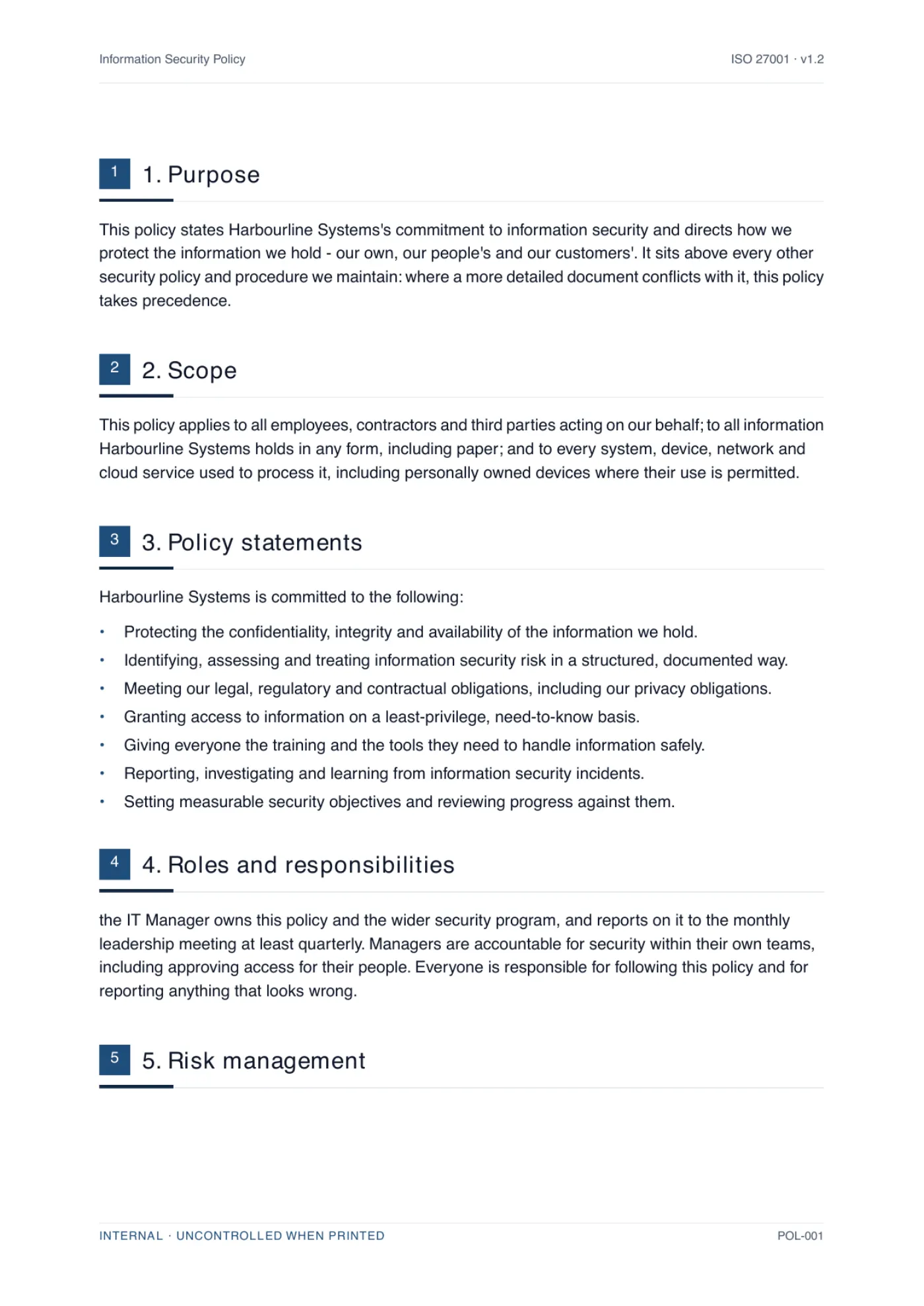
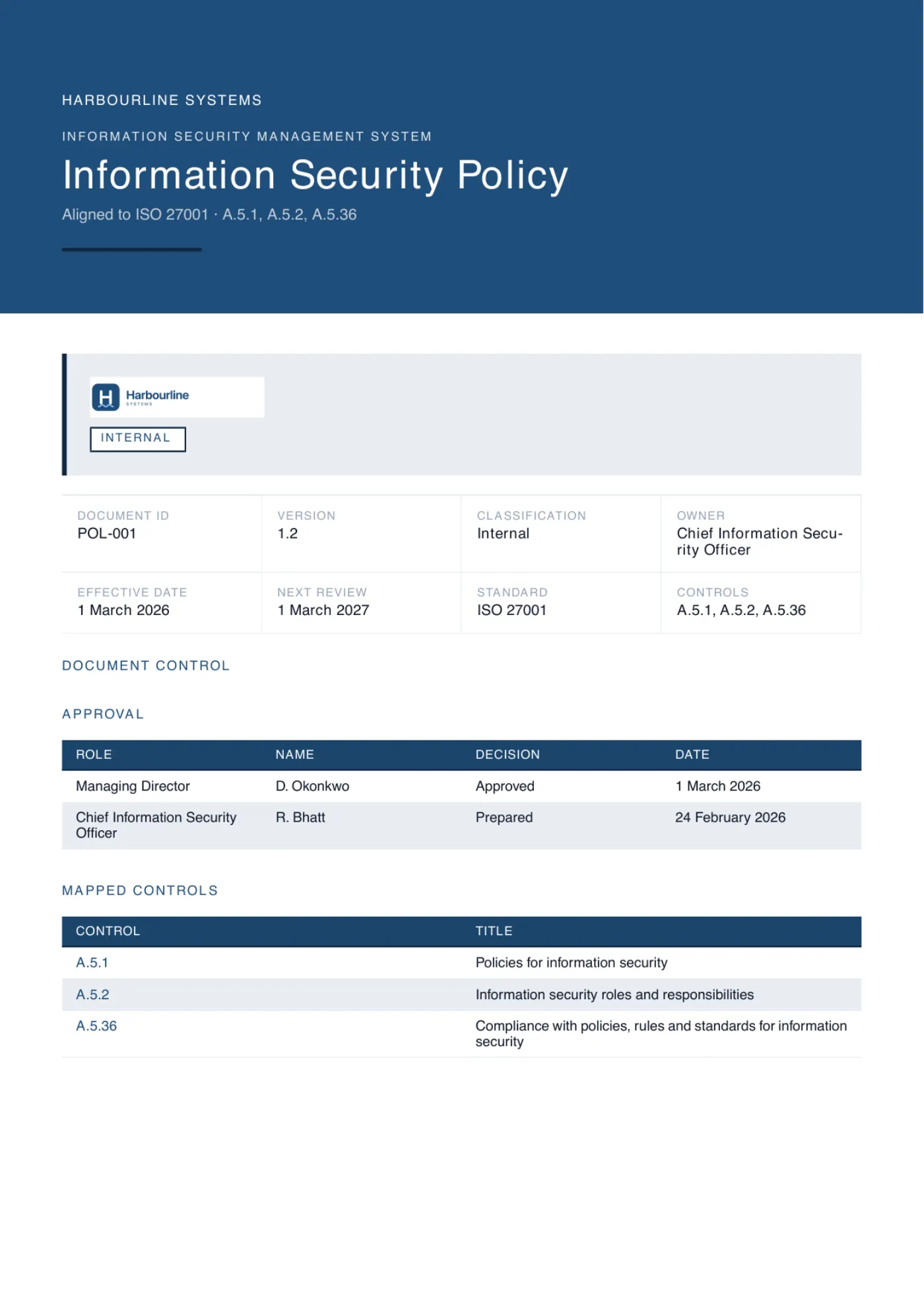
Every decision the guide above leaves to you comes back already made: a named owner reporting into the management forum you actually hold, classification tiers matching the labels your business already uses, the access review and risk review cadences you set, and a completed approval and version block. The supporting policies beneath it are written to agree with it. The cover in the hero and the body page below are this document generated for an example company, in that company's branding, shown exactly as PolicyMint renders it.
Side by side
Writing it yourself vs generating it
Both columns end with the same document in your hands. The difference is who settles the decisions inside it, and what is left over for you to maintain afterward.
| Dimension | Writing it yourself | Generating it with PolicyMint |
|---|---|---|
| What you end up with | One top-level information security policy, as good as the hours you can give it | The same document, written from your business profile and ready to circulate |
| Time to a usable draft | A day or two of writing, then the review rounds it takes to agree roles and cadences | Answer a profile once and the draft comes back with those decisions already made |
| Blanks left in it | Every [role], [forum] and review cycle is yours to settle, fill and remember | Filled from your profile, so no bracketed placeholder survives into the document |
| Tailored to your business | Only as far as you rewrite it - a generic template starts you at nothing | Written from your systems, your scope and the cadences you say you can hold |
| Mapped to ISO 27001 | On you to work out which clause and control each section answers | Each section cites what it satisfies, starting with A.5.1 |
| Checked before you use it | Your own read-through, or an hour of a consultant's time | Three independent verifiers on a different AI model, plus a repair pass |
| Agrees with your other documents | On you - separately written policies drift on roles, terms and review cycles | One profile drives everything you generate, so the next document matches this one |
| Branding and formats | Whatever your word processor gives you | Your logo and colors, exported to Word, PDF and Excel |
| Price | Free, plus the hours - and every clause is yours to maintain | A$10.00US$6.50£5.00€6.00 for this document, and your first one is free |
Card required; no charge today. One-time pricing, not a subscription - you buy credits when you need a document. If you go on to need the rest of the ISO 27001 set, the pack works out at about A$8.75US$5.73£4.48€5.23 a finished document. See pricing.
- ISO 27001 documents
-
36
ISO 27001 documents
tiered by what you actually need
- ISO 42001 documents
-
21
ISO 42001 documents
for AI management systems
- Clauses and controls mapped
-
182
Clauses and controls mapped
every document cites the ones it satisfies
- Verifiers per section
-
3
Verifiers per section
on a different model to the writer
Information security policy FAQ
The questions people ask
Including how far a template gets you before an audit.
What are the 5 key elements of an information security policy?
Scope and purpose - what the policy covers and the commitment behind it. Roles and responsibilities - who owns security and what each person must do. Acceptable use - how systems, data and credentials may be used. Access control - least-privilege, need-to-know access, reviewed regularly and removed when someone leaves. Incident response - how incidents are reported, investigated and learned from. The guide on this page walks through all five, and adds risk management, classification, suppliers, continuity, training and review.
How do I write an information security policy?
Start from a structure rather than a blank page, then adapt it to how your business actually runs: name real roles instead of placeholders, list the systems and data you really hold, and set rules you can genuinely enforce. Keep the top-level policy short and principle-based, and push the operational detail into supporting policies. Then have management approve it, give it an owner, a version number and a review date, tell everyone it exists, and keep a record that you did.
How long should an information security policy be?
Two to four pages is normal for the top-level policy, and shorter is usually better. It exists to state the commitment, set the principles, assign ownership and point to the documents that carry the detail. Once it starts specifying password lengths or backup schedules it has become a procedure, and it will be out of date within months. Put that material in the supporting policies, where it can change without needing management approval again.
Is a free information security policy template enough for ISO 27001?
No. A single policy is one document; certification needs a whole consistent set - the Statement of Applicability, a risk methodology and register, and the topic policies your controls require, each mapped to what it satisfies. Auditors spot generic, copied policies quickly, because nothing they sample in the business lines up with what the document claims. PolicyMint generates the full set from your business profile instead, so it holds together under questioning.
How much does a full ISO 27001 policy set cost?
A certifiable ISO 27001 set is around 36 documents. PolicyMint covers it with a single one-time pack of A$350US$229£179€209 including GST, about A$8.75US$5.73£4.48€5.23 per finished document, with no ongoing platform subscription. Your first document is free. Certification itself is a separate cost, paid to an auditor and a certification body.
Stop staring at an empty document set
Set up your business once. Get the documents you actually need, written for how you really operate, in your branding, checked before you see them.
Your first document is on us. We ask for a card to begin and you are not charged for it, and there is no sales call. See pricing