Skip to content

Free template · Word download · Writing guide

AI Impact Assessment Template

A free, editable AI impact assessment template - the procedure, and a record to complete for each AI system - you can copy or download as a Word document, no sign-up. Below it, a guide to every section: what each one has to contain, the four clauses people get wrong, and what an auditor asks for once assessments are running. When you would rather not fill it in, PolicyMint generates the procedure for your business and checks it before you see it - and your first document is free.

Last updated

Rather not fill it in yourself? Have it generated in your branding instead. Card required to download that one; no charge today.

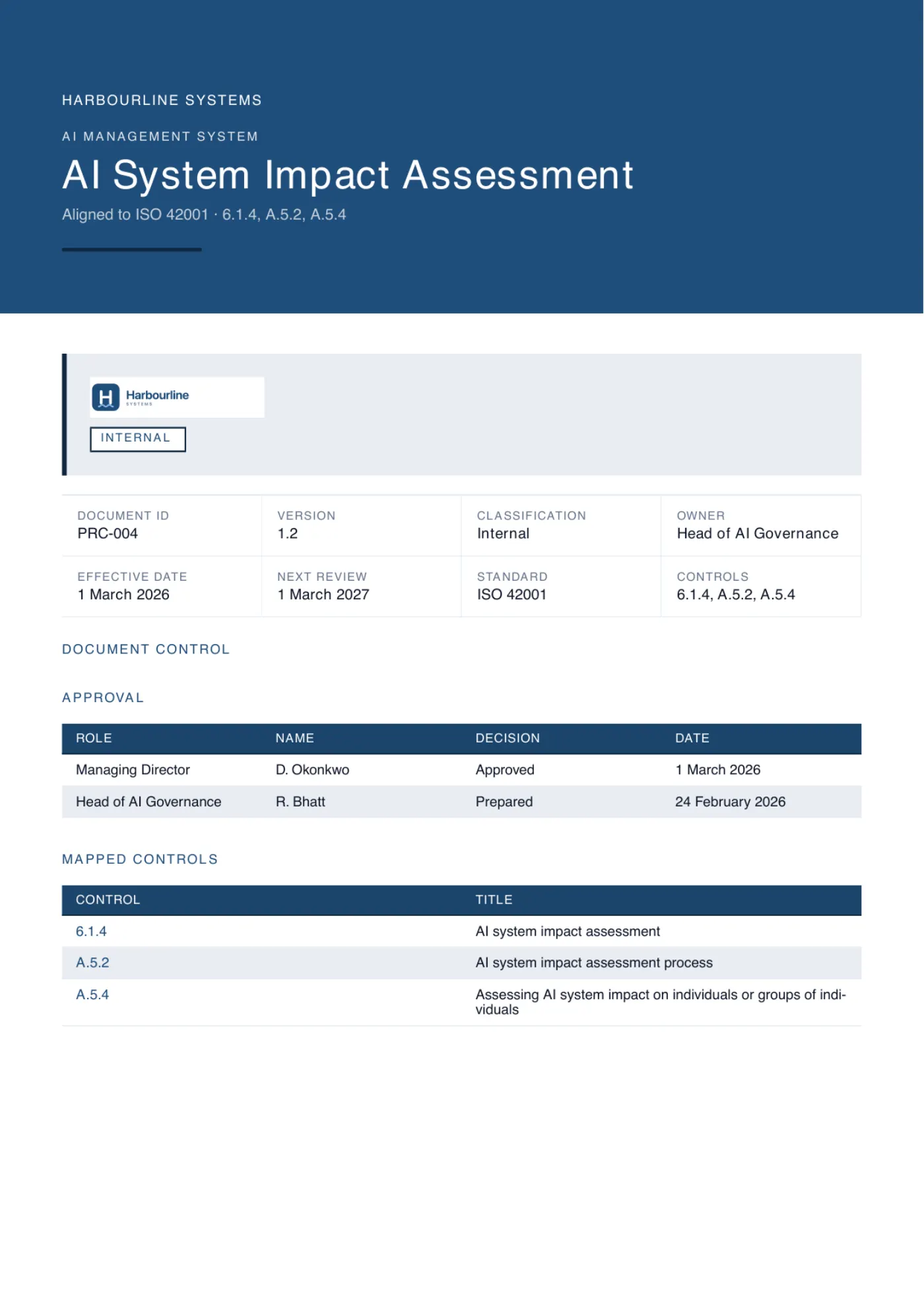
The cover page of a generated AI impact assessment procedure, branded for an example company, showing its document control block, approval table and the ISO controls it maps to.
Generated from this page's structure, in an example company's branding

Free template

Free AI system impact assessment template

The complete AI impact assessment, free to copy from this page or download as an editable Word document. No sign-up. Replace every [bracketed placeholder] with your own details, delete anything that does not apply, and have it approved before you rely on it. The guide below explains what each section has to contain and what an auditor checks.

Free template, full text Download Word (.docx)

AI System Impact Assessment - Template

An editable AI system impact assessment procedure, with the assessment record to complete for each AI system. Replace the bracketed placeholders with your own details.

[Organization] develops, provides or uses AI systems that can affect people who never chose to interact with them. This procedure sets out how we assess the potential impacts of each AI system on individuals, groups of individuals and society, before it is deployed and throughout its life, how we decide whether and how to proceed, and how we record the result. The assessment record in section 15 is completed for each AI system and updated at every review.

1. Purpose

This procedure defines how [Organization] identifies and assesses the potential consequences an AI system can have for individuals, groups of individuals and society as a result of its development, provision or use. It exists so that those consequences are understood and acted on before harm occurs, and so that every decision to deploy, change or retire an AI system can be traced to a documented assessment.

This assessment is separate from, and feeds into, the AI risk assessment. The risk assessment asks what an AI system could mean for [Organization]; this assessment asks what it could mean for the people and communities it touches.

2. Scope

This procedure applies to every AI system [Organization] develops, provides to others or uses in its operations within the scope of [our AI management system], including AI features built into third-party products where [Organization] decides how they are used. It applies from the point a new AI system is proposed until it is retired.

Any exclusion is recorded here with its reason: [exclusions and reasons, or "None"].

3. When an assessment is required

No AI system is deployed, and no significant change is put into use, until the impact assessment for it has been approved under section 10. An assessment is completed, or the existing one reviewed and updated, in each of the following situations:

  • A new AI system is proposed, whether it is built in-house, bought, or enabled as a feature of a product we already use.
  • A significant change is proposed to an existing AI system, for example a new model or model version, new training or input data, a change in the degree of automation, or the removal of a human review step.
  • An AI system is to be used for a new purpose, in a new context or location, or by or on a new group of users or affected people.
  • An incident, complaint or near miss suggests the system has caused, or could cause, an impact the current assessment did not identify.
  • The periodic review falls due, at least [annually] for each AI system in scope.

4. Roles and responsibilities

  • Assessment owner - [role, for example the product or system owner] leads the assessment for each AI system, gathers the information in section 5, completes the assessment record and tracks mitigation actions to completion.
  • Contributors - the assessment owner involves the people who understand the system and the people it affects, including [roles, for example the data owner, a technical lead, the privacy lead, legal or compliance, and customer-facing staff]. Where practical, the views of affected people or their representatives are sought [through (method)].
  • Approver - [role, for example the AI governance committee or a named executive] reviews each completed assessment and makes the decision in section 10. The approver is not the assessment owner for the same system.
  • AI governance lead - [role] owns this procedure, keeps the register of AI systems and their assessments, and reports on assessment status to [management forum] at least [quarterly].

5. Describing the AI system

Each assessment starts with a description of the AI system, recorded with the assessment record. It covers:

  • Intended purpose - what the system is for, the outputs or decisions it produces, and what it is not intended to be used for.
  • Users - who operates the system or acts on its outputs, inside and outside [Organization].
  • Affected people - who is subject to its outputs, including people who never interact with it directly.
  • Data - the data used to train, test and operate it, where that data comes from, and whether it includes personal or sensitive information.
  • Deployment context - where and how it is used, in which locations and jurisdictions, and what else in the process depends on it.
  • Degree of automation and human oversight - whether outputs are advisory, reviewed by a person before they take effect, or acted on automatically, and who can intervene or override.
  • Supplier and version - for a bought or third-party system, the supplier, the model or product version assessed, and the information the supplier has provided about it.

6. Identifying who is affected

The assessment identifies everyone the AI system could affect. Affected people include those who do not use the system and may not know it is involved in a decision about them. Where a group could be affected differently from others, the assessment names that group rather than describing affected people only in general terms.

Affected people are identified at three levels:

  • Individuals - the people a single output is about or acts on, for example an applicant, a customer or an employee.
  • Groups of individuals - groups who could be affected differently from others, for example by age, disability, language, location or another characteristic relevant to the context.
  • Society - effects beyond the people directly involved, for example on access to an essential service, on public trust or on the environment.

7. Assessing potential impacts

For each individual, group and societal effect identified in section 6, the assessment considers the potential impacts of the AI system, beneficial and harmful, both when it works as intended and when it fails or produces errors. Each impact is rated for severity and likelihood on the scales in the table below, before and after mitigation, and recorded in the assessment record. Where information is missing, the assessment records the gap and the action to close it rather than assuming the impact is low. [Use the same scales as your AI risk assessment methodology where you have one, and replace these if they differ.]

At a minimum the assessment considers:

  • Fairness and non-discrimination - whether outputs could be less accurate, or less favorable, for some groups than for others.
  • Privacy - whether the system collects, infers or exposes personal information beyond what people would reasonably expect.
  • Safety - whether an output, or acting on one, could cause physical or psychological harm.
  • Access to services - whether the system could restrict or delay someone's access to work, credit, housing, education, health care or another service.
  • Transparency and the ability to contest a decision - whether affected people know AI is involved, can get an explanation they understand, and can challenge an outcome and reach a person.
  • Wellbeing - whether the system could affect people's autonomy, dignity or mental health, for example through persuasive design or continuous monitoring.
  • Environmental impact - the energy and resources the system uses to train and run, weighed against its benefit.
  • [Any other impact relevant to this system or sector.]
RatingSeverity - how serious the impact would beLikelihood - how likely it is to occur
LowMinor, short-lived inconvenience that is easily reversed.Not expected to occur in normal use.
MediumNoticeable harm to individuals that can be put right with some effort.Could occur in some circumstances.
HighSignificant harm to individuals or a group, or harm that is hard to reverse.Expected to occur at some point in normal use.
Very highSerious or lasting harm to individuals, a group or society, or harm that cannot be reversed.Expected to occur often, or already occurring.

8. Reasonably foreseeable misuse

The assessment also considers how the AI system could be used in ways it was not intended for but that can reasonably be foreseen, and the impacts that would follow. Each foreseeable misuse with a material impact is recorded as its own line in the assessment record. Consider at least:

  • Using outputs for a decision the system was not designed or tested for.
  • Relying on outputs without the human review this assessment assumes.
  • Using the system on people, data or locations outside those it was tested on.
  • Deliberately manipulating inputs to obtain a particular output.

9. Mitigation measures and human oversight

For each impact that is not acceptable as it stands, the assessment records one or more mitigation measures, the owner of each and the date by which it will be in place, then re-rates the impact to give the residual concern. Mitigations can include changes to the system or its data, limits on where and how it is used, information given to affected people, a route to contest a decision, monitoring, and human oversight.

Where human oversight is relied on as a mitigation, the assessment names the role that provides it, what that person reviews, the authority and time they have to override or stop the system, and how their interventions are recorded. A human review step that cannot change the outcome is not recorded as a mitigation.

10. Decision and approval

On the basis of the assessment, the approver makes one of three decisions and records it, with the reasons, in the assessment record. Any impact with a residual severity of [High] or above is escalated to [role or forum] for the decision. The approver records their name, title and the date of the decision, and the assessment owner records when each condition has been met and what shows it.

The three decisions are:

  • Proceed - the residual impacts are acceptable and no further conditions apply.
  • Proceed with conditions - the system may be deployed or changed only once the listed mitigations are in place, or only within stated limits, each condition with an owner and a date.
  • Do not proceed - the residual impacts are not acceptable. The system is not deployed, or the change is not made, until it is redesigned and reassessed.

11. Link to the AI risk assessment

The results of each impact assessment are passed to [role responsible for the AI risk assessment] and considered in the AI risk assessment. Each impact with a residual severity of [High] or above, and each open condition, is reflected in the AI risk register as a risk to [Organization], cross-referenced to the assessment record by its reference number. Where the risk assessment selects a treatment that changes the system, the impact assessment is updated to match.

12. Documenting and retaining results

Each completed assessment, including the record, the evidence it relied on and the approval, is stored in [location, for example the AI governance register] under a unique reference and a version number. Earlier versions are kept, not overwritten, so that the assessment in force on any past date can be shown. Assessments are retained for [period, for example the life of the AI system plus (number) years], or longer where a legal or contractual obligation requires it.

13. Communicating results

Where appropriate, [Organization] makes the results of an impact assessment, or a summary of them, available to relevant interested parties such as customers, users, affected people or their representatives, and regulators where required. [Role] decides what is shared, with whom and in what form, taking account of confidentiality, security and legal obligations, and records that decision. Affected people are told how to raise a concern or contest a decision about them [through (channel)].

14. Review

Each assessment is reviewed at least [annually], and whenever one of the triggers in section 3 occurs. The review checks whether the system, its use, the people it affects or its impacts have changed, whether conditions and mitigations are in place and working, and whether any complaint, incident or monitoring result points to an impact the assessment missed. A review that finds no change is still recorded, with its date.

This procedure is owned by [role]. Approved by [name], [title], on [date]. Version [x.x]. Next review [date].

15. Assessment record

Complete one record for each AI system, and keep it with the system description from section 5.

  • Reference: [AIIA-001]. AI system and version: [name, version].
  • Assessment owner: [role]. Contributors: [roles]. Date: [date].
  • Trigger: [new system / significant change / new use or users / incident / periodic review].
  • Decision: [proceed / proceed with conditions / do not proceed]. Reasons: [summary]. Approved by: [name, title, date].
  • AI risk register reference: [risk IDs]. Next review: [date].
Impact areaWho is affectedDescriptionSeverityLikelihoodMitigation and oversightResidual concernOwner
Fairness and non-discrimination[Group, for example applicants whose first language is not English][How outputs could be less accurate or less favorable for this group][High][Medium][For example, test results by group before release, and a person reviews every adverse outcome][Medium, monitored (monthly)][Role]
Transparency and the ability to contest[Individuals the output is about][Whether they know AI is involved and can challenge the outcome][Medium][High][For example, a notice at the point of use and a named contact who can review the decision][Low][Role]
Privacy[Individuals whose data is used][What personal information is used, inferred or exposed][Severity][Likelihood][Mitigation][Residual concern][Role]
Foreseeable misuse: [describe][Who is affected][What would happen][Severity][Likelihood][Mitigation][Residual concern][Role]
[Impact area][Who is affected][Description][Severity][Likelihood][Mitigation][Residual concern][Role]

This template gives you a working procedure and a record to complete for each AI system, but a generic procedure on its own does not make an ISO/IEC 42001 AI management system. That needs the whole set - an AI policy, an AI risk assessment, a Statement of Applicability and the other documents your controls require - each tailored to your AI systems and consistent with the others. Some laws also set their own assessment requirements for certain AI systems; check which apply to you, because this template is not written to satisfy any particular law. PolicyMint generates the AI System Impact Assessment Procedure and the rest of the set, tailored to your business and checked before you see it.
The guide

How to write an AI impact assessment

15
sections
4
with real wording
7
auditor requests
7
failure modes

An AI impact assessment asks a question an ordinary risk assessment does not: what could this system mean for the people and communities it touches, rather than for the organization running it. The template answers it in two parts - a procedure that says when an assessment happens, who carries it out and who decides, and a record completed for each AI system. Here is every section in order, what each has to contain and what an assessor is checking when they read it. Four of them carry an example clause, because those four are the ones people get wrong.

  1. Purpose

    What it must contain

    Say that the procedure assesses the consequences an AI system can have for individuals, groups of individuals and society, and that it feeds the AI risk assessment rather than replacing it. Two short paragraphs is enough.

    What the auditor checks

    Whether you understand the difference between harm to people and risk to the organization. A purpose that talks only about business risk tells them the assessment is pointed the wrong way.

  2. Scope

    What it must contain

    Which AI systems are covered - built, provided to others and used - including AI features inside products you buy, from proposal to retirement. Record any exclusion with its reason.

    What the auditor checks

    They compare it with your list of AI systems. A system in use that the scope quietly leaves out is the first thing they find.

  3. When an assessment is required

    What it must contain

    The events that start an assessment or a reassessment: a new system, a significant change, a new use or user group, an incident or complaint, and the periodic review. Then make the assessment a gate, not a formality.

    What the auditor checks

    They pick a system that changed recently and ask to see the assessment that change triggered.

    Wording that works
    No AI system is deployed, and no significant change is put into use, until the impact assessment for it has been approved under section 10.

    Without this sentence the triggers are a list of good intentions, and an assessment written a month after launch is a description of what already happened. It ties every trigger to the decision in section 10, so the order of events is checkable from two dates. Keep "significant change" concrete in the bullets above it - a new model version, new data, less human review - or every change will be argued down to insignificant.

  4. Roles and responsibilities

    What it must contain

    An assessment owner per system, the contributors they must involve, an approver who is not the owner, and the role that owns the procedure and reports on it to a management forum at a stated frequency.

    What the auditor checks

    That the approver is independent of the person who wants the system live, and that the named roles exist on your org chart.

  5. Describing the AI system

    What it must contain

    Intended purpose and what it must not be used for, users, affected people, data and its source, deployment context and jurisdictions, the degree of automation and human oversight, and for a bought system the supplier and version assessed.

    What the auditor checks

    Whether the description matches the system in production. An assessment of last year's model version is an assessment of a different system.

  6. Identifying who is affected

    What it must contain

    Everyone the system could affect, at three levels - individuals, groups of individuals and society - with any group that could be affected differently named specifically.

    What the auditor checks

    They look for the people who are not users: the applicant scored, the customer routed, the member of the public in the camera's view.

    Wording that works
    Affected people include those who do not use the system and may not know it is involved in a decision about them.

    The people most exposed to an AI system are often the ones who never touch it, and an assessment that lists only users misses them by design. This sentence makes non-users part of the method rather than an afterthought. The sentence after it in the template matters as much: name the group, because "customers" is not an answer to whether some customers are treated worse than others.

  7. Assessing potential impacts

    What it must contain

    For each affected party, the impacts when the system works and when it fails - fairness and non-discrimination, privacy, safety, access to services, transparency and the ability to contest a decision, wellbeing and environmental impact - each rated for severity and likelihood before and after mitigation, with defined scales.

    What the auditor checks

    Whether the ratings are reasoned or just filled in. A column of "Low" with no evidence reads as a form completed rather than a question asked.

  8. Reasonably foreseeable misuse

    What it must contain

    How the system could be used in ways it was not intended for but that can be foreseen - outputs used for untested decisions, review skipped, use outside the tested population, manipulated inputs - and the impact of each.

    What the auditor checks

    Whether you thought past the intended use. A system described only as it is meant to work has not been assessed against how it will actually be used.

  9. Mitigation measures and human oversight

    What it must contain

    For every impact not acceptable as it stands, the mitigations, their owners and dates, and the re-rated residual concern. Where human oversight is a mitigation, say exactly what it is.

    What the auditor checks

    They ask to speak to the person named as the human in the loop, and ask when they last overrode the system.

    Wording that works
    Where human oversight is relied on as a mitigation, the assessment names the role that provides it, what that person reviews, the authority and time they have to override or stop the system, and how their interventions are recorded. A human review step that cannot change the outcome is not recorded as a mitigation.

    "A human reviews the output" is the most common mitigation and the least examined. The four things this clause asks for - who, what they see, whether they can stop it, and the record - are what separate oversight from a person clicking approve on every result. If your reviewer has thirty seconds and no override, the honest answer is to say so and rate the residual concern accordingly.

  10. Decision and approval

    What it must contain

    The three outcomes - proceed, proceed with conditions, do not proceed - with reasons, an escalation route for high residual impacts, and the approver's name, title and date.

    What the auditor checks

    That a decision was actually made, by someone with authority to say no, and that the conditions attached to it were followed up.

    Wording that works
    Proceed with conditions - the system may be deployed or changed only once the listed mitigations are in place, or only within stated limits, each condition with an owner and a date.

    Most assessments end here, and most that fail do so because the conditions have no owner and no date, so nobody ever checks them. This wording makes each condition a small commitment that leaves evidence. The template then asks the assessment owner to record when each condition was met and what shows it, which is the entry an auditor will look for.

  11. Link to the AI risk assessment

    What it must contain

    Who receives the results, which impacts are carried into the AI risk register as risks to the organization, how the two are cross-referenced, and that a risk treatment which changes the system updates the impact assessment.

    What the auditor checks

    They trace one high impact from the assessment record into the risk register and back by its reference number.

  12. Documenting and retaining results

    What it must contain

    Where completed assessments, evidence and approvals are stored, a unique reference and version for each, earlier versions kept rather than overwritten, and a retention period.

    What the auditor checks

    They ask for the assessment that was in force on a date in the past. If each review overwrote the last, you cannot show it.

  13. Communicating results

    What it must contain

    Who decides what is shared, with whom and in what form, where it is appropriate to share results with interested parties, and how affected people raise a concern or contest a decision.

    What the auditor checks

    Whether the contest route exists in practice: a channel someone monitors, not an address in a footer.

  14. Review

    What it must contain

    A review cycle for each assessment, the triggers that bring it forward, what the review checks, and the document control for the procedure itself: owner, approver, date, version and next review.

    What the auditor checks

    Dated review entries, including the ones that found nothing had changed.

  15. Assessment record

    What it must contain

    A header naming the system, version, owner, trigger, decision, approver and linked risk IDs, and one line per impact: impact area, who is affected, description, severity, likelihood, mitigation and oversight, residual concern and owner.

    What the auditor checks

    The record is what they sample. They read one line against the system in production and ask whether it is still true.

This is not a data protection impact assessment: that one looks only at privacy risk from processing personal data, while this one weighs privacy alongside fairness, safety, access to services, transparency, wellbeing and environmental impact. Some laws set their own assessment requirements for certain AI systems or for personal data, so check which apply to you; this template is not written to satisfy any particular one.

Two neighboring documents carry what this one deliberately leaves out. The organization's own exposure from the same AI system belongs in the AI risk assessment, which the AI risk assessment template covers. The rules staff follow when they use AI tools day to day belong in the AI policy template, not here.

Two jobs sit outside the clause list and are worth more than any sentence inside it: get the procedure approved by someone with the authority to stop a system, and keep a list of every AI system in scope with the assessment that belongs to it. A procedure that has never been run against a real system is an intention rather than a control, and the rest of your evidence is weighed on that basis.

Get it written for your organization - your first document is free Card required; no charge today.

Evidence, not wording

What an auditor actually checks

Assessors rarely comment on how the procedure is written. They pick an AI system and follow it through: the assessment, the decision, the conditions, the risk register, the last review. Every question below leads off the page into a record you either have or do not. Answer them about one of your own systems before somebody else does.

Which AI systems are in scope, and where is the assessment for each?

Satisfies A list of AI systems where every line points to an approved assessment record with a date and a version, including the AI features inside products you buy.

Fails Assessments for two systems you piloted last year and none for the one that went live last quarter.

This system changed recently. Where is the updated assessment?

Satisfies A change record for the new model, data source or workflow, and a reassessment approved before the change was put into use.

Fails An assessment that still describes the previous model version, approved a year before the system changed.

Who did you consider affected?

Satisfies Named individuals, groups and societal effects, including people who never use the system, with the groups that could be treated differently called out by name.

Fails A single line reading "users of the system".

Who is the human in the loop, and can they stop it?

Satisfies The role named in the record, what they review, their authority to override, and a log that shows interventions actually happen.

Fails A reviewer who approves every output because the workflow gives them no way to change one.

Show me that a condition was met.

Satisfies A "proceed with conditions" decision whose conditions each have an owner, a date and a closure entry pointing at the evidence.

Fails Conditions listed at approval and never mentioned again.

How did this reach the AI risk assessment?

Satisfies A high residual impact that appears in the AI risk register, cross-referenced to the assessment record by its reference number.

Fails An impact assessment and a risk register that never mention each other.

When was it last reviewed?

Satisfies Dated review entries later than the original approval, including the ones that record no change.

Fails A next-review date that has passed with no review recorded.

Notice how little of that is about the procedure itself. The document is where the conversation starts, and almost every answer sits in a completed record, a change log or a register. That is why a borrowed procedure is such a poor trade: it tells an assessor what should exist and gives you nothing to show them.

Failure modes

Where impact assessments usually go wrong

The same faults account for most of what gets flagged, and very few of them are writing problems. Run your procedure, and one completed record, past each of them before you send it for approval.

  • Assessing the company instead of the people

    Reputational damage, fines and lost revenue in the impact column. Those belong in the AI risk assessment. The impact assessment asks what happens to the person on the other end of the output, and an assessment that never mentions them has not been done.

  • Only the users counted

    The staff who operate the system are listed; the applicants it scores and the customers it routes are not. The people most exposed to an AI system are often the ones who never see it.

  • Done once, at launch

    The assessment describes the model the system shipped with, and nobody reopened it when the model, the data or the workflow changed. An assessment that no longer matches production is evidence of the gap rather than of the control.

  • Human oversight on paper only

    "A person reviews every decision" is written as the mitigation, but the reviewer has seconds per case, no override and no record of ever disagreeing. Oversight that cannot change the outcome is not a mitigation.

  • Every impact rated low

    A column of low ratings with no reasoning, often because nobody had the data to know. Missing information is a finding to record and close, not a reason to assume the best.

  • Conditions nobody closes

    The system was approved to proceed with conditions, and the conditions have no owner, no date and no closure entry. The approval then rests on mitigations that may never have happened.

  • Bought systems left out

    AI features inside purchased software are treated as the supplier's problem. You decide how the output is used and on whom, so the impact of that use is yours to assess, with whatever the supplier can tell you.

From template to audit-ready

Why a template alone will not pass ISO 42001

An impact assessment procedure is one document. ISO/IEC 42001 is a management-system standard, and an audit against it looks for a whole, consistent set: an AI policy, an AI risk assessment, a Statement of Applicability and the other documents your chosen controls require, each tailored to the AI systems you develop, provide or use and none contradicting the others. A generic template, or a folder of unconnected ones, is exactly what auditors flag.

For this document specifically, the standard comes at it twice. Clause 6.1.4, AI system impact assessment, sits in planning, where the process is defined; clause 8.4, AI system impact assessment, sits in operation, where assessments are carried out and their results kept. Annex A adds four controls: A.5.2 AI system impact assessment process, A.5.3 Documentation of AI system impact assessments, A.5.4 Assessing AI system impact on individuals or groups of individuals, and A.5.5 Assessing societal impacts of AI systems. That is why the template separates individuals, groups and society, and why the evidence questions above are about records rather than wording. ISO/IEC 42005, published in 2025, gives guidance on AI system impact assessment and is worth reading alongside it.

See what ISO 42001 requires and the documents you need for the whole management system. The ISO 42001 controls list sets the four impact assessment controls in the context of all of Annex A. For the control-level detail, our sibling site ControlStack has a plain-English breakdown of what ISO/IEC 42001 asks for in practice.

See the real output

What PolicyMint generates

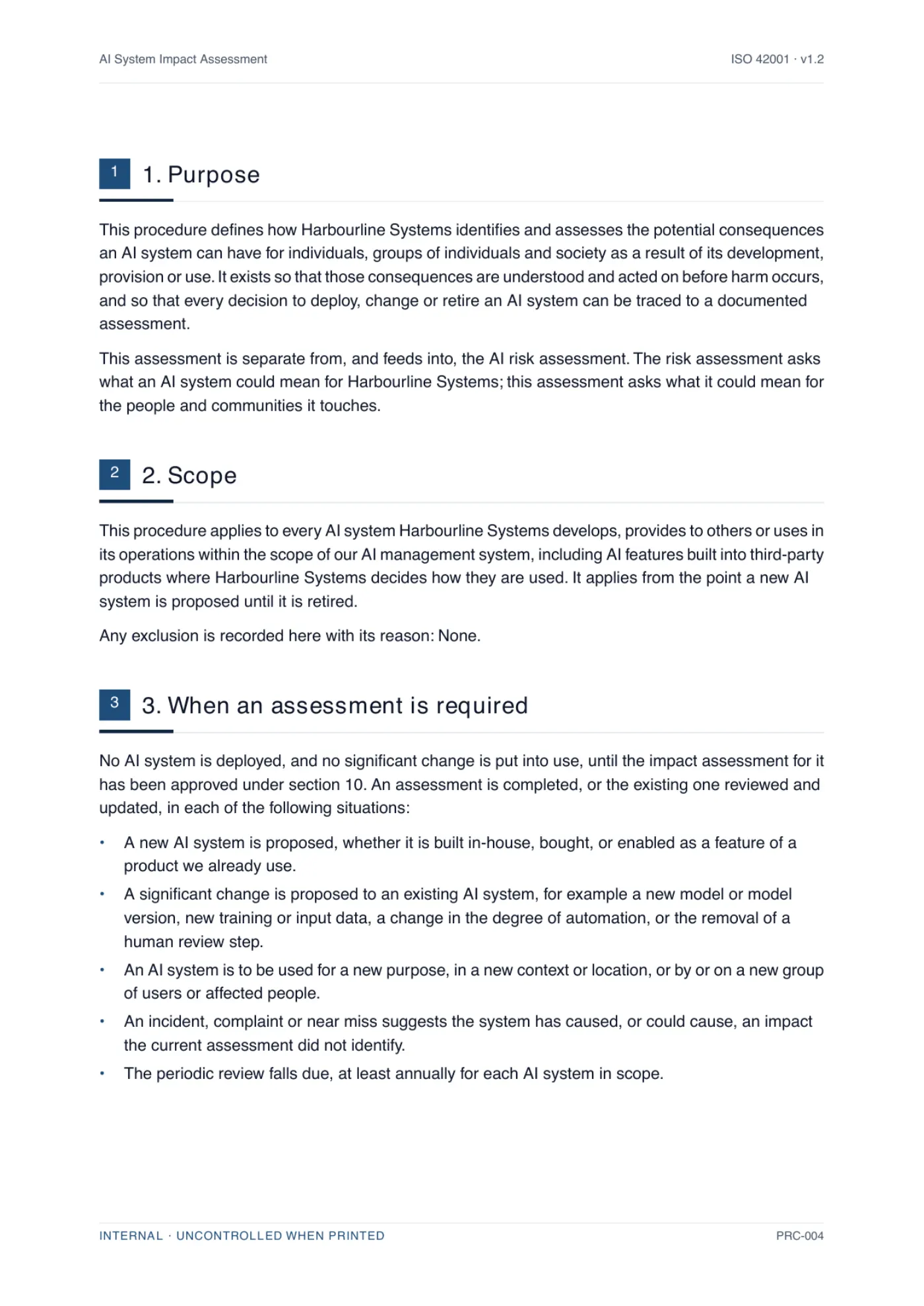
PolicyMint generates this document as the AI System Impact Assessment Procedure. The decisions the guide above leaves to you come back already made: the roles that own, contribute to and approve an assessment, the triggers and review cycle you say you can hold, and a completed approval and version block. It is written to agree with your AI policy and AI risk assessment. The cover in the hero and the body page below are this document generated for an example company, in that company's branding, shown exactly as PolicyMint renders it.

A body page of a generated AI impact assessment procedure, showing numbered clauses written for a specific business with the placeholders resolved.
One page of the generated document, for an example company. The trial produces the whole document, not a sample.

Where the guide says [role] or [system], the document says yours; where PolicyMint cannot know a fact, it asks rather than guesses.

The PolicyMint guided review: a generated scope statement with one highlighted sentence that needs the reader's input, and beside it a review panel explaining what is needed, a field to answer it, and the choice between having the answer written in or inserted exactly as typed.

The one fact this document could not know stays highlighted in the document and the export. The review explains what is needed and writes your answer in. Nothing is invented. Fictional demo data.

Side by side

Writing it yourself vs generating it

Both columns end with the same document in your hands. The difference is who settles the decisions inside it, and what is left over for you to maintain afterward.

Dimension Writing it yourself Generating it with PolicyMint
What you end up with One impact assessment procedure and record, as good as the hours you can give it The AI System Impact Assessment Procedure, written from your business profile and ready to circulate
Time to a usable draft A day or two of writing, then the review rounds it takes to agree owners, approvers and triggers Answer a profile once and the draft comes back with those decisions already made
Blanks left in it Every [role], [forum], trigger and review cycle is yours to settle, fill and remember Filled from your profile, so no bracketed placeholder survives into the document
Tailored to your business Only as far as you rewrite it - a generic template starts you at nothing Written from your business profile and the AI systems you develop, provide or use
Mapped to ISO 42001 On you to work out which clause and control each section answers Each section cites the ISO 42001 clause or control it satisfies
Checked before you use it Your own read-through, or an hour of a consultant's time Three independent verifiers on a different AI model, plus a repair pass
Agrees with your other documents On you - a separately written procedure drifts from your AI policy and risk assessment One profile drives everything you generate, so the next document matches this one
Branding and formats Whatever your word processor gives you Your logo and colors, exported to Word, PDF and Excel
Price Free, plus the hours - and every clause is yours to maintain A$10.00US$6.50£5.00€6.00 for this document, and your first one is free
ISO 27001 documents

36

ISO 27001 documents

tiered by what you actually need

ISO 42001 documents

21

ISO 42001 documents

for AI management systems

Clauses and controls mapped

182

Clauses and controls mapped

every document cites the ones it satisfies

Verifiers per section

3

Verifiers per section

on a different model to the writer

AI impact assessment FAQ

The questions people ask

Including what ISO 42001 asks for and how often to review.

Is this AI impact assessment template free to download?

Yes. The complete template, the procedure and the assessment record, is on this page and as an editable Word document, with no sign-up and no card. Replace the bracketed placeholders, delete what does not apply, and have it approved before you rely on it. If you would rather have the procedure written for your organization, with your roles, triggers and review cycle filled in, PolicyMint generates it and your first document is free; we ask for a card only when you download that one, and it is not charged.

What is an AI impact assessment?

A structured look at what an AI system could mean for the people and communities it touches: the individuals its outputs are about, groups who could be affected differently, and society more widely. It covers impacts such as fairness, privacy, safety, access to services, transparency and the ability to contest a decision, wellbeing and environmental impact, rates each one, records the mitigations, and ends in a decision on whether and how the system proceeds. It is separate from the AI risk assessment, which looks at risk to the organization, and feeds into it.

Does ISO 42001 require an AI impact assessment?

Yes. ISO/IEC 42001:2023 covers it in clause 6.1.4 (AI system impact assessment) and clause 8.4 (AI system impact assessment), and in Annex A controls A.5.2 to A.5.5, which address the assessment process, documenting the assessments, and assessing impacts on individuals or groups of individuals and on society. ISO/IEC 42005, published in 2025, gives guidance on AI system impact assessment. Some laws have their own assessment requirements for certain AI systems, so check which apply to you; this template is not written to satisfy any particular law.

How often should an AI impact assessment be reviewed?

Set a cycle you can keep - the template defaults to at least annually - and bring the review forward whenever something changes: a new model or data source, a new use or group of affected people, less human review, or an incident or complaint that points to an impact the assessment missed. Record every review with its date, including the ones that find no change.

How much does an ISO 42001 document set cost?

PolicyMint's Full ISMS / AIMS pack is a one-time A$350US$229£179€209 including GST and covers a complete certifiable ISO 42001 set of 21 finished documents, or a complete ISO 27001 set of 36. Each document is drafted from your own business profile, checked by three independent verifiers before you see it, and exported in your branding as Word, PDF and Excel. There is no subscription and credits are valid for 18 months. Your first document is free, card required.

Ready when you are

Stop staring at an empty document set

Set up your business once. Get the documents you actually need, written for how you really operate, in your branding, checked before you see them.

Your first document is on us. We ask for a card when you download it and you are not charged for it, and there is no sales call.