An incident response plan is a written document that tells an organization how to
recognize, report, contain and recover from a security incident. The plan defines
severity levels, names who leads and who communicates, sets response timeframes, and
records the evidence, notification and review steps that follow every incident.
This page gives you a free, editable incident response plan template to copy or
download as a Word document, no sign-up. Below it, a guide to filling it in: every
section in order and what each has to cover, example wording for the four clauses people
get wrong, how to set severity and the response clocks, and what an ISO 27001 auditor
asks to see.
Rather not fill it in yourself? Have
this one document generated in your branding instead -
the signup credits cover the first one. Card required to download that one; no charge today.
Generated from this page's structure, in an example company's branding
Free template
Free incident response plan template
The complete incident response plan, free to copy from this page or download as an editable Word document.
No sign-up. Replace every [bracketed placeholder] with your own details, delete anything that
does not apply, and have it approved before you rely on it. The guide below
explains what each section has to contain and what an auditor checks.
Replace the bracketed placeholders with your own roles, channels and deadlines.
[Organization] uses this incident response plan to detect, contain and recover from security incidents consistently. It applies to every suspected or confirmed incident affecting [Organization]'s information, systems or people.
1. Purpose and scope
This plan covers all staff, contractors and suppliers, all company data wherever it is held, and every system and cloud service [Organization] depends on.
2. What counts as an incident
An incident is any event that has compromised, or is likely to compromise, the confidentiality, integrity or availability of [Organization]'s information or systems. When in doubt, report it.
Confirmed or suspected unauthorized access to an account, device or system.
Malware, ransomware, or unexpected encryption of company data.
Personal or customer data sent, exposed or published to the wrong party.
Loss or theft of a device, a credential or a physical record.
Serious misuse of company systems or a deliberate breach of security policy.
3. Roles and responsibilities
[Role, e.g. Security Manager] is the incident lead and owns each incident from report to closure: they set severity, direct the response and close it. [Role] is the communications lead, the only person authorized to speak to customers, regulators or media. [Role, e.g. the CEO] is the executive sponsor and approves anything that stops trading. Responders are named in [on-call roster]; each role has a deputy.
4. Severity and response times
The incident lead sets severity when the incident is identified and may change it as facts emerge. Severity sets the clock.
Severity 1, critical: confirmed data breach, ransomware in production, or a total outage of a customer-facing service. Acknowledge within 15 minutes at any hour; contain within 1 hour.
Severity 2, high: a compromised account or endpoint, or a successful phishing attack held to one user. Acknowledge within 1 hour in business hours; contain within 4 hours.
Severity 3, medium: suspicious activity with no confirmed compromise, or a misconfiguration exposing internal data. Acknowledge within 4 business hours; resolve within 2 business days.
Severity 4, low: a phishing email reported and not acted on, or a minor policy breach. Acknowledge next business day; resolve within 5 business days.
5. Reporting
Report immediately to [channel, e.g. security@example.com], and to [after-hours number] outside hours. Nobody is penalized for reporting something harmless. Do not power off, wipe or tidy up an affected device unless the incident lead says so.
6. Response phases
Preparation: keep contacts, access, backups, logging and this plan current, and rehearse.
Identification: recognize and record the event, from monitoring or a person, confirm it is real, set severity and name the incident lead.
Containment: stop the spread by isolating hosts, disabling accounts and revoking sessions and tokens.
Eradication: remove the cause - the malware, the exposed credential, the vulnerable configuration.
Recovery: restore from known-good backups, monitor closely, and confirm normal operation before closing.
Lessons learned: run the post-incident review in section 9 and track every action it raises to closure.
7. Evidence and chain of custody
Preserve what you can before changing anything: isolate rather than power off, capture logs and disk or memory images, and screenshot with timestamps. Log every item with who collected it, when, and where it is stored, and sign each handover. That chain of custody is what makes evidence usable by an insurer, a regulator or a court.
8. Notification and communications
The communications lead runs all messaging. Where an eligible data breach is likely to cause serious harm, [Organization] notifies the Office of the Australian Information Commissioner and the affected individuals as soon as practicable, assessing within 30 days. Where the EU or UK GDPR applies, the supervisory authority is notified within 72 hours of becoming aware. [Role] checks customer contracts, whose deadlines are often shorter.
9. Post-incident review
Every severity 1 and 2 incident gets a written review within 10 business days; lower severities are reviewed together each quarter. The review records the timeline, the root cause, and the changes that prevent a repeat. Every action has an owner and a due date, and feeds the risk register. Reviews look for causes, not blame.
10. Testing and maintenance
Tested annually with a tabletop exercise, and again after any severity 1 incident. Contact lists verified quarterly. Owned by [role]. Approved by [name], [title], on [date]. Version [x.x].
A plan alone is not an ISO 27001 incident response capability. An auditor also wants the incident records it produced and the improvements they drove. PolicyMint generates that full set, tailored to your business and checked before you see it.
Write it yourself
How to write an incident response plan
10
sections
4
with real wording
6
auditor requests
6
failure modes
1-2 days
to write it yourself
A plan someone can follow at 2am is short, specific and rehearsed, and ten sections do the
job. Each entry below is a brief rather than the wording itself, because the answers have to
be yours. Four of the ten carry an example clause, because they are the four that go wrong
most often.
1
Purpose and scope
What it must contain
One paragraph fixing the boundary: who the plan binds, which information it covers, and which systems sit inside it. Write the boundary you actually have.
What the auditor checks
Scope is how they decide whether a given event should have followed this plan. A vague boundary turns every incident you handled informally into a process failure you cannot argue your way out of.
2
What counts as an incident
What it must contain
A one-line definition, then a short set of examples drawn from your own systems so nobody has to interpret the definition under pressure.
What the auditor checks
They describe an event and ask whether it counts. If your people would answer differently from your document, detection is not working no matter what the tooling says.
3
Roles and responsibilities
What it must contain
Who leads an incident, who does the containment work, who is allowed to speak publicly, and who can authorize a decision that costs money. Job titles, each with a deputy.
What the auditor checks
They check the roles map to real people who know they hold them. In a small business one person may hold two - say so, rather than inventing a team that does not exist.
Wording that works
[Role] is the communications lead, the only person authorized to speak to customers, regulators or media.
It names a role rather than a department, and the word only carries the clause: it is what stops a well-meaning engineer answering a journalist mid-incident.
4
Severity and response times
What it must contain
A small number of levels defined by impact rather than cause, each carrying its own clocks, plus a line saying who sets severity and who may change it.
What the auditor checks
These are the numbers your own incident records get held against, so they have to be times you can genuinely staff at 3am on a Sunday.
5
Reporting
What it must contain
Where a report goes, what happens out of hours, and what an employee must not do to an affected device before the lead arrives.
What the auditor checks
Under-reporting is invisible until they interview staff. They ask a non-technical employee where they would report a suspicious email and compare the answer with what you wrote.
Wording that works
Report immediately to [channel], and to [after-hours number] outside hours. Nobody is penalized for reporting something harmless.
One destination instead of a chain of command, and amnesty in writing - which is what turns a twelve-hour delay into a ten-minute one.
6
Response phases
What it must contain
The standard handling sequence, written as instructions rather than theory. Use the canonical names and order, set out further down this page.
What the auditor checks
They trace one real incident through the phases in order. A cleared symptom with the exposed credential still valid is the classic finding: recovery was done, eradication was not.
7
Evidence and chain of custody
What it must contain
What gets captured before anything is changed, and the record of who held each item and when.
What the auditor checks
Less an ISO question than an insurance and legal one, but it surfaces the moment an incident touched personal data: they ask how you established what was actually accessed.
8
Notification and communications
What it must contain
The deadlines that legally bind you, an owner for each, and the test that starts each clock. Contracts usually run shorter than the law, so name who checks them.
What the auditor checks
They compare the date you became aware with the date you notified. A plan with no clock in it cannot evidence that the clock was met.
Wording that works
Where [trigger test] is met, [Organization] notifies [regulator] and the affected individuals within [deadline], counted from the moment we become aware.
The order is what makes it work: the test that starts the clock, then the deadline, then who gets told. Write one of these per regime that actually binds you, and delete the rest - a plan listing laws you are not subject to reads as copied.
9
Post-incident review
What it must contain
Which incidents earn a written review and how fast, what the review must record, and where its actions go afterward.
What the auditor checks
This is the improvement loop, and it is the section they push hardest on. They want an action from the last review that is closed, dated and traceable to something that changed.
Wording that works
Every severity 1 and 2 incident gets a written review within 10 business days, and every action carries an owner and a due date.
It is testable: two dates and a list an auditor can open. Compare it with the version most plans carry, which promises that a review will be held - a sentence nobody can ever fail and nobody can ever verify.
10
Testing and maintenance
What it must contain
How often the plan is exercised, what forces an extra test, and the document control block that dates and owns it.
What the auditor checks
The first thing they look at and the easiest to fail. A plan last approved two years ago by somebody who has left is a finding before anyone reads the content.
Setting the severity scale
Severity is the first decision in any incident: it sets who gets woken up and how fast the
clock runs. Keep it to four levels, define each by impact rather than cause, and write the
response times beside them. The grid below is the shape, not a calibration to copy - severity
1 shows what a tight clock reads like, and the rest are yours to set at times your own roster
can genuinely meet at 3am.
Severity 1 (critical)
The business is visibly affected, or data is confirmed to have moved.
Acknowledge within 15 minutes, at any hour. Contain the same hour.
Severity 2 (high)
One account, endpoint or user is compromised, and it is contained there.
Acknowledge inside the business hour.
Severity 3 (medium)
Something looks wrong, but no compromise is confirmed.
Acknowledge the same business day.
Severity 4 (low)
Handled correctly by the person who found it.
Acknowledge the next business day.
Two rules keep a scale honest, and both belong in the text: anyone may raise an incident at
any severity, and only the incident lead may lower one. Re-classify upward the moment the
facts change.
The six response phases
Section six is the spine of the response itself. Use the canonical names and this order, one
line of instruction each - an auditor tracing a real incident expects to find all six, and a
renamed sequence just makes the tracing harder. What each phase is really for:
01
Preparation
Everything you need has to work before you need it. A plan nobody rehearses is a document, not a capability.
02
Identification
Confirm it is real, record it, and put one named person in charge of it.
03
Containment
Stop the spread first. Containment beats investigation, every time.
04
Eradication
Remove the cause, not the symptom. This is the phase most often skipped under pressure.
05
Recovery
Restore from something you trust, then watch it before you call it closed.
06
Lessons learned
The phase thin plans drop and every auditor asks about. No written review, no improvement loop.
Confirming the document exists, is approved and covers the right ground takes about two
minutes. The rest of the session is a conversation about what your organization did the last
time something went wrong. These are the questions, close to verbatim, and what a good answer
looks like.
?
Show me the incidents you handled in the last twelve months.
Satisfies
A register with the date and time each was raised, its severity, who led it, what was done and when it closed - low-severity ones included.
Fails
An empty register reads as a detection failure, not a quiet year.
?
Who decided this one was a severity 2?
Satisfies
A person's name against the decision, and criteria in the plan that match how they were applied in practice.
Fails
Severity set by whoever happened to pick up the phone is the common answer and the wrong one.
?
You promised acknowledgment within 15 minutes. Did you make it?
Satisfies
Timestamps from a system you already use - the ticket, the alert, the chat channel - held against your own targets. Missing a target you set is a far smaller problem than having no way to tell either way.
?
What changed because of the last serious incident?
Satisfies
A written review with a root cause, actions carrying owners and due dates, and at least one of them closed and traceable to a real change: a configuration, a new control, a new version of this plan.
?
Who is on call this week, and what happens if they do not answer?
Satisfies
A current roster, a named deputy for every role, and a contact list verified within the period the plan promises.
Fails
A number belonging to someone who left in March is one of the easiest findings an auditor will ever write.
?
When did you last test this, and what broke?
Satisfies
Dated notes from a tabletop exercise listing who attended, what did not work on the day, and what you changed afterward.
Fails
An exercise where nothing went wrong is usually an exercise that was not really run.
One pattern runs through all six: they are checking your records against your own commitments,
not against an external standard of good behavior. That is why the numbers you write into the
plan matter more than how ambitious they sound.
Failure modes
The mistakes that turn into findings
Almost every weak incident response plan fails in one of the same six ways. Read your draft
against this list before anyone else does - each one takes a minute to check and most take an
afternoon to fix.
!
Departments instead of people
"The IT team will contain the incident" describes nobody at 2am. Name the incident lead by job title, name a deputy, and make sure both of them know they hold the role.
!
Response times you cannot staff
Copying a 15-minute acknowledgment into a plan with no on-call roster writes the finding for the auditor: they hold your timestamps against your own promise. Set clocks you can meet today, then tighten them once you can.
!
No usable definition of an incident
Without concrete examples, staff escalate a slow laptop and stay quiet about a password typed into a fake login page. Five examples from your own systems beat a paragraph of theory.
!
A plan you cannot reach during the incident
The plan is in the wiki behind the single sign-on that was just disabled, and the contact list is in a mailbox nobody can open. Keep an offline copy, with printed phone numbers, where the response actually happens.
!
Reflex reimaging
The laptop is wiped within the hour and rebuilt by lunchtime. Months later an insurer or a regulator asks what was taken, and the honest answer is that you cannot say. Isolate, capture, then rebuild.
!
Reviews that change nothing
The review happens, actions get listed, nobody owns them and the plan version never moves. A run of reviews with no closed actions reads as a process that exists but does not work.
From template to audit-ready
Where an incident response plan fits in ISO 27001
ISO/IEC 27001 does not ask for a file with a particular name. It asks you to plan and
prepare for incidents (A.5.24), to assess events and decide which are incidents (A.5.25),
and to respond the way you said you would (A.5.26). A written plan evidences the first; only
your incident records and timings evidence the other two.
Which is why the audit runs the way it does above: the plan itself is checked quickly, and
the rest of the time goes on your records. Sibling site ControlStack goes deeper on the
control behind the first of those three references:
what it expects and what an auditor asks to see.
In Australia, two incidents carry their own legal clocks. A breach of personal information can be
notifiable under the Privacy Act, which the
data breach response plan covers,
and a ransomware or extortion payment must be reported within 72 hours under the Cyber Security Act
2024, which the
ransomware payment reporting procedure covers.
See the real output
What PolicyMint generates
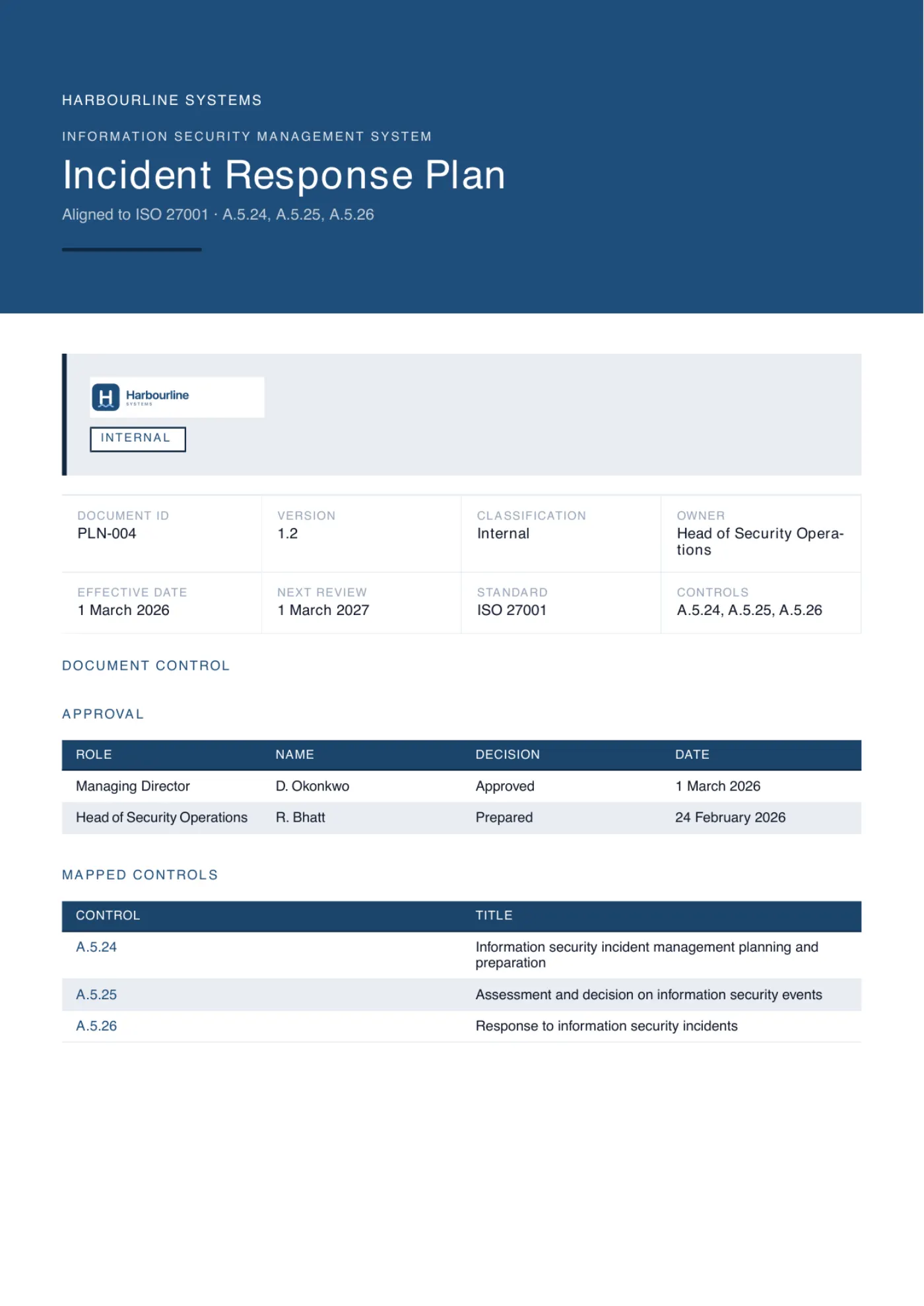
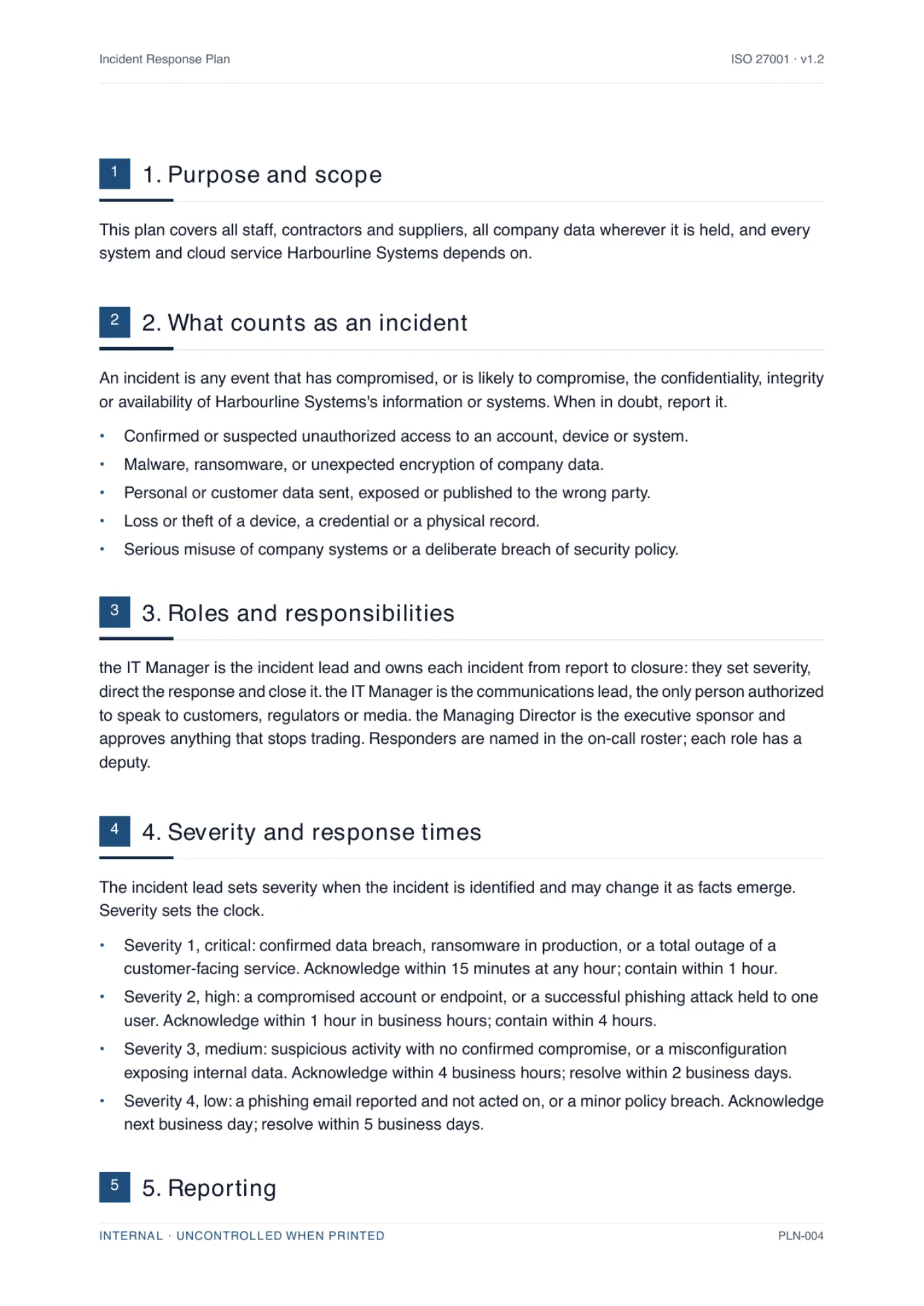
The cover at the top of this page and the body page below are one plan, built to the structure
in the guide and run through PolicyMint's own export path with an example company's branding
applied. Generated for your business, it arrives with the severity scale tuned to your systems
and customers, the incident lead and the single communications lead named as real roles,
acknowledgment and containment clocks you can meet, and the notification deadlines that bind
you - every section verified and cited to A.5.24, A.5.25 and A.5.26.
One page of the generated document, for an example company. The trial produces the whole
document, not a sample.
Where the guide says [role] or [system], the document says yours; where PolicyMint
cannot know a fact, it asks rather than guesses.
Guided reviewActual product
The one fact this document could not know stays highlighted in the document and the
export. The review explains what is needed and writes your answer in. Nothing is
invented. Fictional demo data.
Side by side
Writing it yourself vs generating it
Everything above is what you need to write this plan without us. If you would rather not
spend the day or two, here is the same one document the other way round.
Scroll the table sideways to compare both routes.
Dimension
Writing this plan yourself
Generating it with PolicyMint
What you start from
A blank page, or a generic template whose every decision is still yours to make
The ten sections above, written for your business, with nothing left as a placeholder
Severity and timeframes
Levels and clocks you invent, then have to defend against your own records
Set from your systems, customers and contractual notification deadlines
Named roles
Placeholders you fill in by hand, and remember to change when people move
Real roles from your business profile, used the same way in every document
ISO 27001 evidence
You map the plan to A.5.24, A.5.25 and A.5.26 yourself
Every section cited to the control it satisfies as it is written
Checked before you use it
Your own read-through, or a consultant's hourly rate
Three independent verifiers on a different AI model, plus a repair pass
What it costs
Nothing but the day or two of writing, and the review round after it
A$10.00US$6.50£5.00€6.00 for this plan on its own, or about A$8.75US$5.73£4.48€5.23 a document if you later take the full set
ISO 27001 documents
36
ISO 27001 documents
tiered by what you actually need
ISO 42001 documents
21
ISO 42001 documents
for AI management systems
Clauses and controls mapped
182
Clauses and controls mapped
every document cites the ones it satisfies
Verifiers per section
3
Verifiers per section
on a different model to the writer
Incident response plan FAQ
The questions people ask
Including the reporting clocks and who belongs on the team.
What is an incident response plan?
An incident response plan is a written document that tells an organization how to recognize, report, contain and recover from a security incident. It defines severity levels, names the incident lead and the single communications lead, sets acknowledgment and containment timeframes, and states how evidence is preserved, who is notified, and how the incident is reviewed afterward.
What are the 6 phases of incident response?
Preparation, identification, containment, eradication, recovery and lessons learned. That is the SANS incident handling sequence: get ready before anything happens, confirm the event is real and put someone in charge, stop the spread, remove the cause rather than the symptom, restore from something you trust, and close with a written review that raises actions.
Who should be on an incident response team?
At minimum an incident lead who owns the incident and sets severity, responders who contain and eradicate, one communications lead who is the only person speaking to customers, regulators or media, and an executive sponsor who can approve stopping trading. Name a deputy for each; in a small business one person may hold two roles.
How quickly do I have to report a data breach?
It depends which law applies. Under the Australian Privacy Act's Notifiable Data Breaches scheme you have 30 days to assess a suspected eligible breach, then must notify the Information Commissioner and affected individuals as soon as practicable. Under the EU or UK GDPR you have 72 hours from becoming aware. Contracts are often tighter.
Is this incident response plan template free to download?
Yes. The complete template is on this page and as an editable Word document, with no sign-up and no card. Replace the bracketed placeholders, delete what does not apply, and have it approved before you rely on it. If you would rather have it written for your organization, with your roles, severity levels and notification deadlines filled in, PolicyMint generates it and your first document is free; we ask for a card only when you download that one, and it is not charged.
Is an incident response plan template enough for ISO 27001?
No. The document is one part. An auditor also asks for the incidents you handled, the timestamps against your own targets, who set the severity, the reviews you wrote and the improvements they drove. A generic plan with placeholder roles is a common finding.
How much does a full ISO 27001 document set cost?
PolicyMint's Full ISMS / AIMS pack is a one-time A$350US$229£179€209 including GST and covers a complete certifiable ISO 27001 set of 36 finished documents, or a complete ISO 42001 set of 21. Each document is drafted from your own business profile, checked by three independent verifiers before you see it, and exported in your branding as Word, PDF and Excel. There is no subscription and credits are valid for 18 months. That is about A$8.75US$5.73£4.48€5.23 per finished document. For comparison, Advisera publicly lists about A$1,300 (US$897)US$897about £660 (US$897)about €780 (US$897) one-time for pre-written templates you complete with its AI copilot, and GRC Solutions (formerly IT Governance) about A$950 (£495)about US$670 (£495)£495about €580 (£495) excl. VAT. Certification itself is a separate cost, paid to an auditor and a certification body.
Ready when you are
Stop staring at an empty
document set
Set up your business once. Get the documents you actually need, written for how you really operate, in your branding, checked before you see them.