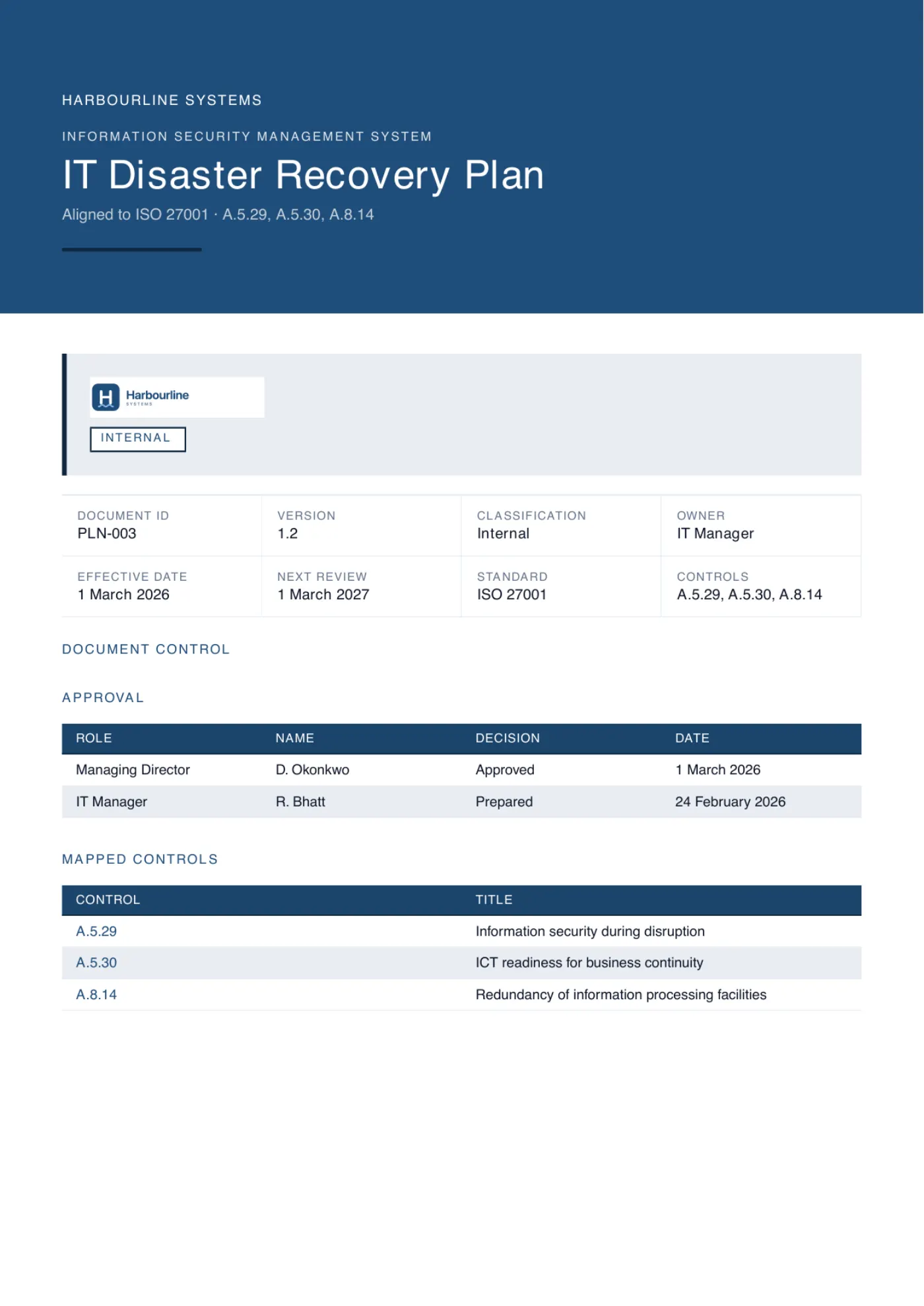
IT Disaster Recovery Plan - Template
An editable disaster recovery plan for your systems and data. Replace the bracketed placeholders with your own details.
[Organization] runs on a set of systems, data and infrastructure that have to come back, in the right order and in a known-good state, after an outage, a cyber attack or the loss of a site. This plan records which systems they are, how fast each has to be back and how much data we can afford to lose, who declares a disaster, and how each system is restored, checked and handed back.
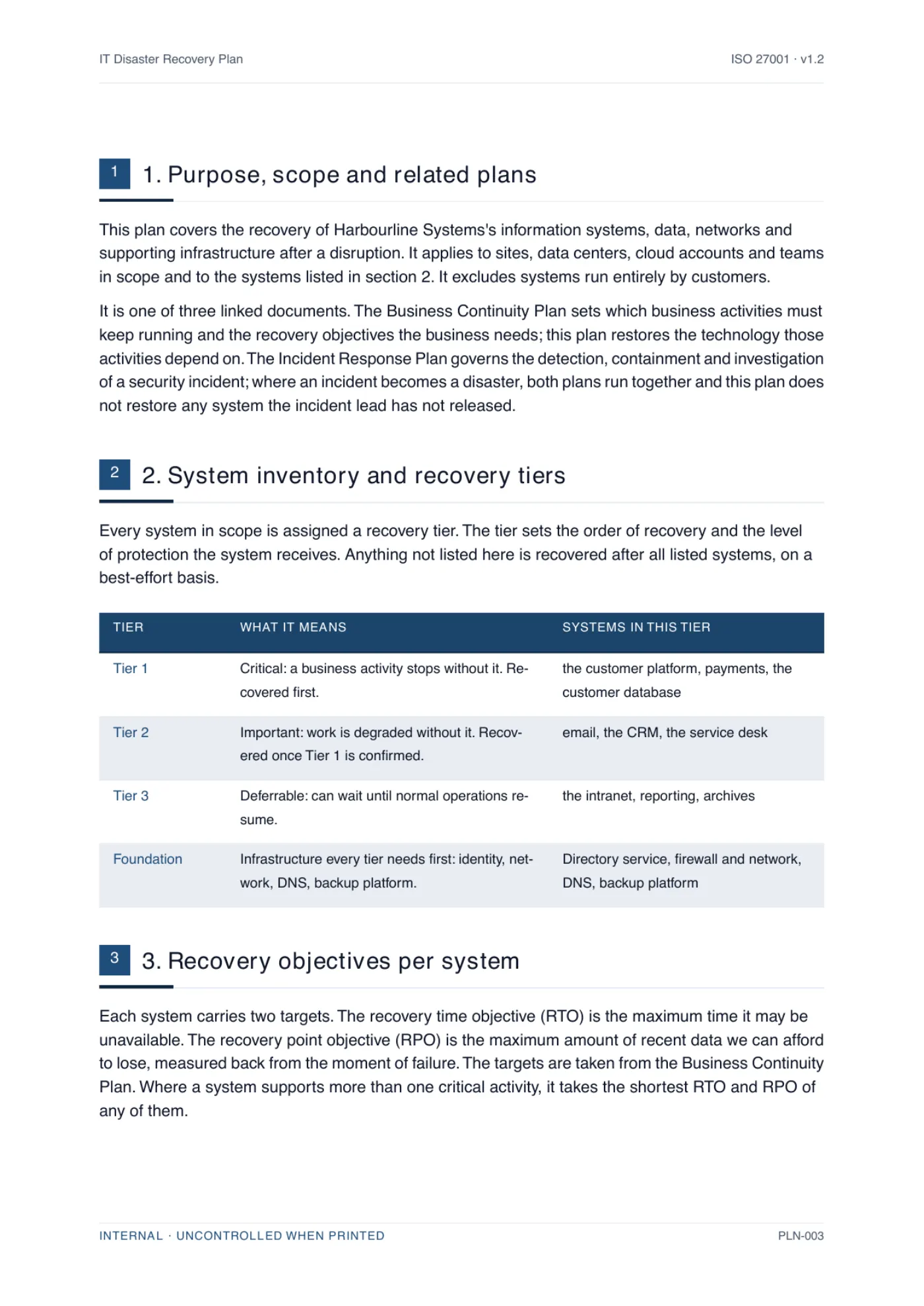
1. Purpose, scope and related plans
This plan covers the recovery of [Organization]'s information systems, data, networks and supporting infrastructure after a disruption. It applies to [sites, data centers, cloud accounts and teams in scope] and to the systems listed in section 2. It excludes [anything out of scope, for example systems run entirely by a customer].
It is one of three linked documents. The Business Continuity Plan sets which business activities must keep running and the recovery objectives the business needs; this plan restores the technology those activities depend on. The Incident Response Plan governs the detection, containment and investigation of a security incident; where an incident becomes a disaster, both plans run together and this plan does not restore any system the incident lead has not released.
2. System inventory and recovery tiers
Every system in scope is assigned a recovery tier. The tier sets the order of recovery and the level of protection the system receives. Anything not listed here is recovered after all listed systems, on a best-effort basis.
| Tier | What it means | Systems in this tier |
|---|---|---|
| Tier 1 | Critical: a business activity stops without it. Recovered first. | [for example the customer platform, payments, the customer database] |
| Tier 2 | Important: work is degraded without it. Recovered once Tier 1 is confirmed. | [for example email, the CRM, the service desk] |
| Tier 3 | Deferrable: can wait until normal operations resume. | [for example the intranet, reporting, archives] |
| Foundation | Infrastructure every tier needs first: identity, network, DNS, backup platform. | [Directory service], [firewall and network], [DNS], [backup platform] |
3. Recovery objectives per system
Each system carries two targets. The recovery time objective (RTO) is the maximum time it may be unavailable. The recovery point objective (RPO) is the maximum amount of recent data we can afford to lose, measured back from the moment of failure. The targets are taken from the Business Continuity Plan. Where a system supports more than one critical activity, it takes the shortest RTO and RPO of any of them.
| System | Tier | RTO | RPO | System owner | Depends on |
|---|---|---|---|---|---|
| [System] | [1] | [4 hours] | [15 minutes] | [Role] | [Directory service], [database], [supplier] |
| [System] | [1] | [8 hours] | [1 hour] | [Role] | [Network], [cloud region] |
| [System] | [2] | [1 business day] | [4 hours] | [Role] | [System above] |
| [System] | [3] | [5 business days] | [24 hours] | [Role] | [Backup platform] |
4. Roles and responsibilities
Every role has a named alternate. Contact details for all of them are held in [location], in a form still readable when [Organization]'s own systems, email and directory are unavailable.
| Role | Responsibilities during recovery | Primary | Alternate |
|---|---|---|---|
| DR coordinator | Declares a disaster, sets recovery priorities, keeps the decision log, reports to [management role]. | [Name or role] | [Name or role] |
| Technical recovery team | Restores foundation infrastructure, then systems in tier order, following the runbooks in section 8. | [Names or roles] | [Names or roles] |
| System owners | Confirm each restored system and its data are correct and usable before it is handed back. | [Role per system] | [Role per system] |
| Communications lead | Every update to staff, customers and outside parties, on the schedule in section 11. | [Name or role] | [Name or role] |
| Supplier liaison | Opens and chases cases with the suppliers and cloud providers in section 10. | [Name or role] | [Name or role] |
5. Invocation: declaring a disaster
Any suspected disaster is reported to [role or channel]. The DR coordinator decides whether to invoke this plan; if they cannot be reached within [30 minutes], [alternate role] decides instead. The decision, the time and the reason are recorded in the decision log, including a decision not to invoke.
Not every outage is a disaster. The plan is invoked when any of the following is true, or is expected to become true:
- A Tier 1 system is unavailable, or is expected to remain unavailable, for longer than [half its RTO].
- A primary site, data center or cloud region is lost or inaccessible.
- Data in a Tier 1 or Tier 2 system is corrupted, encrypted or destroyed and cannot be repaired in place.
- The incident lead advises that systems must be rebuilt rather than cleaned.
6. Recovery strategies
Each tier is protected by a strategy able to meet its targets. The strategy for each system is recorded in its runbook.
- Restore from backup: rebuild the system and restore data from the most recent good backup. The default for Tier 2 and Tier 3.
- Redundancy: duplicate components within the primary site or cloud region (for example clustered servers, redundant network links or replicated storage) so a single failure does not stop the service.
- Failover to a secondary site or cloud region: [warm standby, pilot light or replicated environment] at [location or region], able to take over [Tier 1 systems] within their RTO.
- Supplier-provided recovery: for software-as-a-service systems, the provider's own recovery commitments, together with our own export or backup of the data where the provider's arrangements do not meet our RPO.
- Where a system's strategy cannot meet its targets, the gap is recorded as a risk in the information security risk register, and either the strategy is funded or the targets are changed and re-approved.
7. Backup arrangements
Backups are the last line of recovery and are protected accordingly. At least one copy of every Tier 1 and Tier 2 backup is immutable or offline, held under credentials separate from the production environment, so that an attacker with administrator access to production cannot alter or delete it.
| Data or system | Frequency | Copies and location | Immutable or offline copy | Retention | Restore test |
|---|---|---|---|---|---|
| [Tier 1 system] | [Every 15 minutes] | [Primary region] and [secondary region] | [Yes - immutable storage] | [35 days] | [Quarterly] |
| [Tier 2 system] | [Daily] | [Primary region] and [offsite location] | [Yes - offline copy] | [90 days] | [Every six months] |
| [Tier 3 system] | [Weekly] | [Backup platform] | [Yes] | [1 year] | [Annually] |
| [Software-as-a-service data] | [Daily export] | [Location] | [Yes] | [Period] | [Every six months] |
8. Recovery runbooks
[Role] maintains a runbook for every Tier 1 and Tier 2 system, stored at [location] with a copy reachable when our network is down. Each runbook follows the same structure:
- The system, its tier, RTO, RPO, owner and the systems it depends on.
- Prerequisites: the infrastructure, accounts, licenses and encryption keys that must be available first, and where each is held.
- Step-by-step recovery, written for a competent administrator who has never touched this system.
- Validation: the checks the system owner performs to confirm the data is complete and the system is usable.
- Handback and rollback: how the system is returned to users, and what to do if recovery fails part way.
- Last tested date, elapsed recovery time measured, and the runbook version.
9. Ransomware and cyber attack recovery
Recovering from an attack differs from recovering from a failure: the attacker may still be present, and the most recent backup may already contain their changes. In any recovery following a cyber attack:
- No system is restored into an environment that has not been declared clean by [role, with the incident lead]. Rebuild into an isolated, known-good environment where there is any doubt.
- The restore point is chosen as the most recent backup taken before the earliest evidence of compromise, not simply the most recent backup. Where that point is uncertain, restored systems are scanned before they are reconnected.
- All privileged, service and administrator credentials are reset, and multi-factor authentication is re-enrolled for administrators, before restored systems are reconnected to the network.
- Evidence required by the incident lead is preserved before systems are wiped or rebuilt.
- Decisions about contacting law enforcement, insurers, regulators or the attacker are made by [role] under the Incident Response Plan, not by the technical recovery team.
10. Supplier and cloud provider dependencies
For every supplier or cloud provider a Tier 1 or Tier 2 system depends on, we record the recovery commitment in the contract, the out-of-hours support route, and our own fallback if they cannot meet our targets.
| Supplier or provider | Systems affected | Contracted recovery commitment | Support route | Our fallback |
|---|---|---|---|---|
| [Cloud provider] | [Systems] | [Commitment, or 'none in contract'] | [Portal, phone, account reference] | [Fail over to region], [restore from our own backup] |
| [Software-as-a-service provider] | [System] | [Commitment] | [Contact] | [Our data export], [manual process under the Business Continuity Plan] |
| [Managed service or network provider] | [Systems] | [Commitment] | [Contact] | [Secondary link or provider] |
11. Communications during recovery
The communications lead issues updates to staff through [primary channel], with [out-of-band channel, for example SMS] as the fallback when our own systems are unavailable, at least every [2 hours] while a Tier 1 system is down. Customer and external messages follow the Business Continuity Plan and are approved by [role]. Every update gives the systems affected, what has been restored, and the time of the next update, with recovery estimates taken from the technical recovery team rather than from hope.
12. Return to normal operations and failback
A system is recovered when its owner has confirmed the data is complete and the system is usable, and the security controls in the runbook are back in place. [Organization] returns to normal operations when all Tier 1 and Tier 2 systems are recovered and the DR coordinator stands the plan down, recording the time and the reason.
Failback from a secondary site or cloud region is scheduled as a planned change, approved by [role], and is not started until a fresh backup has been taken at the recovery site. The recovery environment is kept available until the primary has run normally for [3 business days]. A post-recovery review is held within [10 business days], and its actions are recorded with an owner and a due date.
13. Testing and exercising
The plan is tested on the schedule below, after any significant change to systems, sites or suppliers, and after any real invocation. Each test records the date, scenario, participants, elapsed time measured against the RTO, what failed, and the actions raised, each with an owner and a due date.
- Tabletop exercise, at least [annually]: the recovery team works through a realistic scenario, including a ransomware scenario, against this plan.
- Restore test, at least [quarterly for Tier 1 and every six months for Tier 2]: a system and its data are restored from backup into an isolated environment, checked by the system owner, and timed.
- Failover test, at least [annually] for each system with a failover strategy: service is moved to the secondary site or region and back.
14. Maintenance and document control
This plan is reviewed at least annually and after any test, invocation or significant change. At each review the system inventory, tiers, recovery objectives, runbook links, supplier details and contact details are re-validated against the current environment.
Owned by [role]. Approved by [name], [title], on [date]. Version [x.x]. Next review [date]. The current copy is stored at [location], with an offline or out-of-band copy at [location] that remains reachable when [Organization]'s systems are down.
A solid starting point, but it is one document. ISO 27001 expects ICT readiness to hold together with the rest of your management system: the recovery objectives your business continuity arrangements set, the risks it treats, the suppliers behind it, and the Statement of Applicability that records the decision. PolicyMint generates that full set, written for your business and checked before you see it.