Skip to content

ISO/IEC 27001 · Topic-specific policy

Cloud Security Policy Template

A working guide to writing one yourself: every section of the document in order, what each has to say and why an auditor cares, real wording for the 4 clauses people get wrong, and the failure modes that turn cloud adoption into a finding.

Rather not write it yourself? Have this one document generated in your branding instead - the signup credits cover the first one. Card required; no charge today.

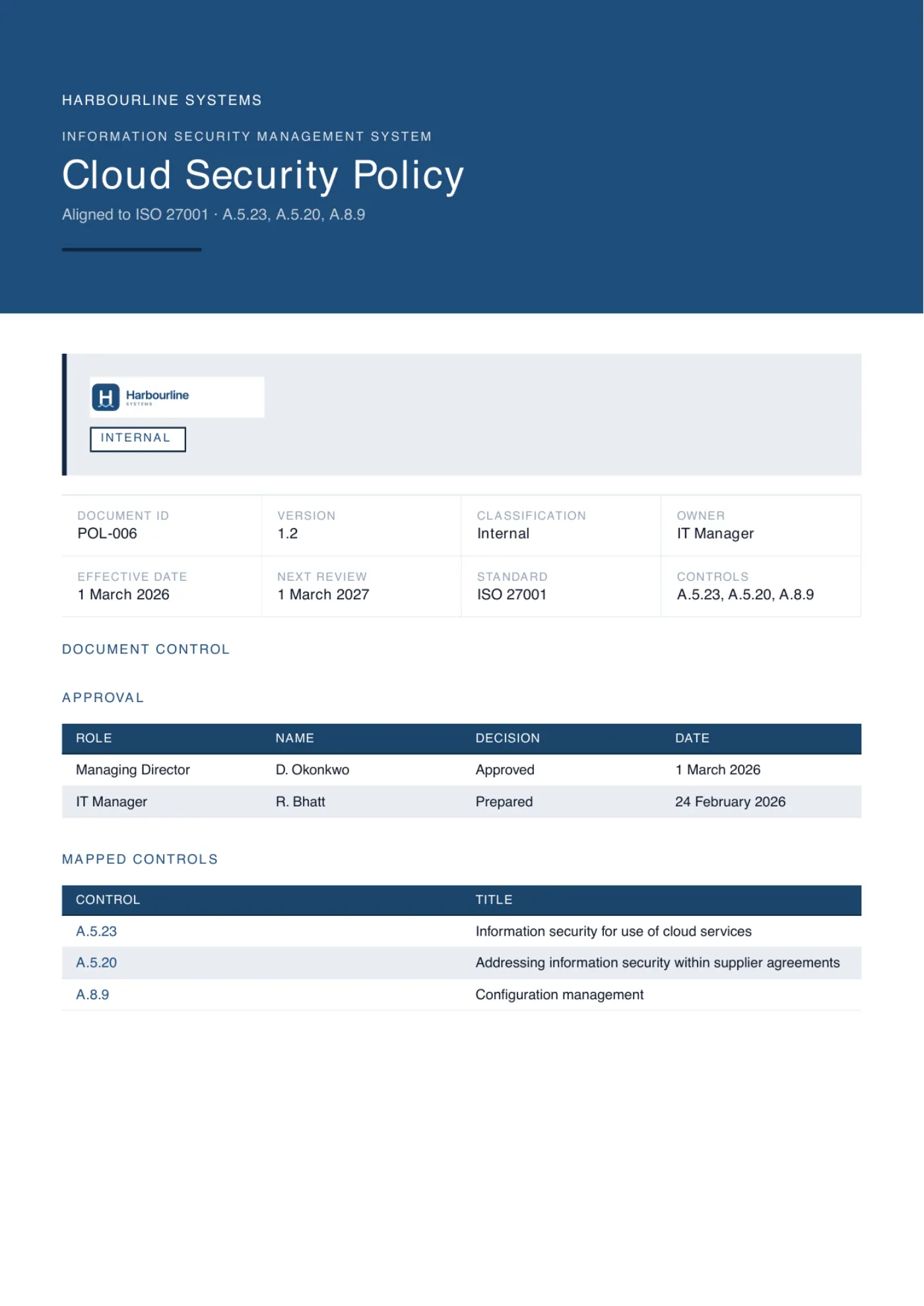
The cover page of a generated cloud security policy, branded for an example company, showing its document control block, approval table and the ISO controls it maps to.
Generated from this page's structure, in an example company's branding

The guide

How to write a cloud security policy

12
sections the document needs
4
wordings people reliably get wrong
7
things an auditor asks to see
a day
to write it yourself

A cloud security policy is the document that sets the rules for how an organization selects, approves, configures and monitors cloud services such as SaaS, PaaS and IaaS. It states who may approve a new service, how data is protected in it, what the provider is responsible for, and what stays your job.

Write it in this order - all 12 sections, three pages, plain sentences - because the policy has to describe the cloud the business actually runs on, not the one the template imagined. The 4 clauses that fail under pressure carry real wording, and why it holds up.

Get this as an editable Word document - your first document is free Card required; no charge today.

  1. Purpose

    What it must contain

    Why the policy exists: the business runs on cloud services, and this document makes adopting them safe and repeatable rather than forbidden.

    What the auditor checks

    Whether the policy is written to be used. A policy that reads as a prohibition gets routed around, and the register that follows it will be empty while the expense report is not.

  2. Scope

    What it must contain

    Every service model - SaaS, PaaS and IaaS - every environment, and everyone who buys, builds on, connects or administers a cloud service, contractors included. Free tiers and trials are in scope.

    What the auditor checks

    The free-tier sentence, specifically. It is the single line that closes the most common gap, because the services nobody paid for are the ones nobody recorded.

  3. Roles and the shared responsibility model

    What it must contain

    Who is responsible for what between you and the provider, stated plainly enough that nobody has to interpret a diagram during an incident.

    What the auditor checks

    This is the clause people get wrong most, and an auditor tests it by asking who secures a specific setting in a specific service. A policy that says 'the provider handles security' fails on the first question.

    Wording that works
    [Organization] uses cloud services under a shared responsibility model. The provider is responsible for the security of the service itself; [Organization] remains responsible for everything it configures and puts into the service, including user accounts and access, security settings, integrations, and the data stored or processed there. Accountability for [Organization]'s information cannot be transferred to a provider, whatever the contract says.

    It splits the responsibility by what each party controls rather than by product name, so it stays true when you add a service the policy has never heard of.

  4. Approved services and the cloud service register

    What it must contain

    The register that makes the policy enforceable: service, business owner, data classification held, storage region, approval date - and a named owner for the register itself.

    What the auditor checks

    They will read the register against reality: the expense report, the SSO logs, the browser extensions. A register nobody owns is the first thing that breaks, because nothing adds to it after the week it was created.

  5. Approving a new cloud service

    What it must contain

    Who approves, what is checked before approval - security certifications, data location, terms, sub-processors - and how long it takes.

    What the auditor checks

    Evidence of the check, not just the outcome. An approval that exists only as a thumbs-up in a chat thread is an approval nobody can reconstruct a year later.

    Wording that works
    Staff must not sign up for, connect or pay for a new cloud service on behalf of [Organization] without approval from [role]. This includes free tiers, trials and AI tools, and it includes connecting a new app to an approved service. Approved services are recorded in the cloud service register; anything not in the register is not approved. If a service you need is missing, request it; approval normally takes [n] business days.

    It names the three cases people assume are exempt, then gives a route and a timeframe - which is what stops the rule being bypassed rather than merely broken.

  6. Accounts, access and administrators

    What it must contain

    Single sign-on wherever the service supports it, multi-factor authentication on everything, least privilege, named administrators, no shared accounts, and leaver access removed the same day.

    What the auditor checks

    Named administrators for the two or three most critical services, and what happened to the last leaver's access. The staff-facing versions of these rules belong in the acceptable use policy; this is the service-side counterpart.

  7. Data protection and residency

    What it must contain

    Which class of information may go into which class of service, encryption in transit and at rest, who holds the keys, and where data is allowed to live.

    What the auditor checks

    Whether residency was decided or defaulted. Most providers offer a region choice once, at setup, and never mention it again.

    Wording that works
    [Organization]'s data may only be stored or processed in the regions recorded in the cloud service register for that service. Where a provider offers a choice of region, [role] selects it before the service goes live and records it. Services that cannot commit to a storage location may not hold [confidential or restricted] information.

    It ties residency to the register rather than to a list that will go stale, and it gives a clear answer for providers that cannot commit - which is the case the generic templates leave out.

  8. Secure configuration and change

    What it must contain

    A baseline for each major platform, who may change security settings, and a periodic check for drift.

    What the auditor checks

    The baseline and the reviewer, by name. Most cloud findings are configuration findings, so this section is where the policy either becomes testable or stays decorative.

  9. Logging and monitoring

    What it must contain

    What is logged for each critical service, who reviews the alerts, how long logs are kept, and that administrator actions are in scope.

    What the auditor checks

    Who read the last alert. Retention and coverage are easy to state and easy to check; the reviewer is the part that is usually missing.

  10. Backup, resilience and exit

    What it must contain

    Backups where the shared responsibility split puts them on you, what you assume during an outage, and an exit note for each critical service.

    What the auditor checks

    The exit note, which almost nobody writes. The provider's durability is not your backup, and 'we would export it' is not a plan until someone has checked the export exists.

    Wording that works
    Before a cloud service holds production data, [role] records how [Organization] would leave it: how data is exported and in what format, how quickly, what the provider deletes after termination and when, and what would replace the service. For each critical service this exit note is reviewed [annually].

    It makes exit a thing recorded before adoption rather than discovered during a dispute, and it names the four facts that actually matter when you have to move.

  11. Contracts and incident notification

    What it must contain

    Security terms in supplier agreements, the provider's duty to notify you of a breach and the clock that starts, and who at your end receives that notice.

    What the auditor checks

    One critical provider's agreement, read for those three things. A critical service on click-through consumer terms is a finding on its own.

  12. Exceptions, breaches and review

    What it must contain

    Who may grant an exception, in writing, with an expiry; what happens when the policy is breached; and an annual review plus triggers - a new critical service, an incident, a provider change.

    What the auditor checks

    Whether the review actually happened, and whether any exception outlived its expiry. An exception with no end date is a policy change nobody approved.

The staff-facing half of section 6 - what an individual may and may not do with an account - belongs in the acceptable use policy rather than here. This document governs the service; that one governs the person using it.

Get this as an editable Word document - your first document is free Card required; no charge today.

At audit

What an auditor actually checks

Nobody is asked to demonstrate that they take cloud security seriously. You are asked for a register, an approval record and an exit note. These 7 requests cover most of what a cloud section of an audit consists of.

Show me your cloud service register.

Satisfies A current register naming each service, its business owner, what data it holds and where that data lives - and it matches what the company actually uses.

Fails Three SaaS subscriptions on the corporate card that appear in no register.

Walk me through how this recently adopted service was approved.

Satisfies A record of what was checked before approval - certifications, data location, terms, sub-processors - and who approved it.

Fails An approval recorded as a chat thumbs-up, with nothing about data location or terms.

Show me multi-factor authentication and administrator accounts for your most critical services.

Satisfies MFA enforced, administrators named individually, and access tied to people who still work here.

Fails A shared admin login for the billing portal, with the password in a spreadsheet.

What is your baseline configuration, and who reviews changes to it?

Satisfies A documented baseline per major platform and a named reviewer, with evidence of a recent check.

Fails A storage bucket set public two years ago that nobody has looked at since.

Show me the supplier agreement for one critical provider.

Satisfies Security terms, a breach-notification obligation with a timeframe, and exit provisions.

Fails A critical provider on click-through consumer terms with no notification clause.

How would you get your data out of this service?

Satisfies The exit note: export format, how long it takes, what the provider deletes and when, and what would replace the service.

Fails No answer beyond hoping the export button works.

When were the policy and the register last reviewed?

Satisfies Dated review records for both, plus changes made after a new critical service or an incident.

Fails A policy dated three years ago naming a platform the business no longer uses.

Failure modes

Where cloud security policies go wrong

None of these are about the cloud. They are about a document written for a business other than yours, and a register nobody kept.

  • The policy bans what the business already runs on

    Written against an imagined estate rather than the real one. The finding writes itself the moment the register shows forty services and the policy allows five. Start from what is in use, decide what to keep, and write the rule that gets you from here to there.

  • A register nobody owns

    The register is the policy's enforcement mechanism, so an unowned one takes the policy down with it. Name an owner, and name the discovery triggers that feed it: supplier onboarding, expense reports, single sign-on logs. Without triggers it records only the services someone remembered to mention.

  • "The provider is certified, so we are covered"

    Their certificate covers their side of the shared responsibility model. Your accounts, your settings, your integrations and your data are still yours, and customer-side misconfiguration is where cloud incidents come from - not provider compromise. A certificate is due diligence evidence, not a control you implemented.

  • An enterprise policy in a ten-person company

    Cloud centres of excellence, tooling mandates and quarterly architecture boards, copied out of a template built for a company with a platform team. An unenforceable clause costs you the enforceable ones, because an auditor who finds one rule nobody follows starts testing the rest.

From template to audit-ready

Where cloud security fits in ISO 27001

A cloud security policy is not an optional extra in ISO 27001. Control A.5.23, information security for use of cloud services, was added in the 2022 revision precisely because cloud adoption outran the old standard: it expects defined processes for acquiring, using, managing and exiting cloud services, and this document is their natural home. The contract and notification rules support A.5.20, addressing information security within supplier agreements. And the configuration clause is where A.8.9, configuration management, becomes visible to an auditor: the baseline, and who signs off changes to it. ControlStack has a plain-English breakdown of cloud service security management if you want the control on its own terms.

One policy, however good, is still one document. Certification needs a whole consistent set: a Statement of Applicability recording a decision for every control, a risk methodology and register, and the topic policies your controls require, each mapped to what it satisfies. See what a certifiable ISO 27001 documentation set contains, and the information security policy template that sits above this one.

See the real output

What PolicyMint generates

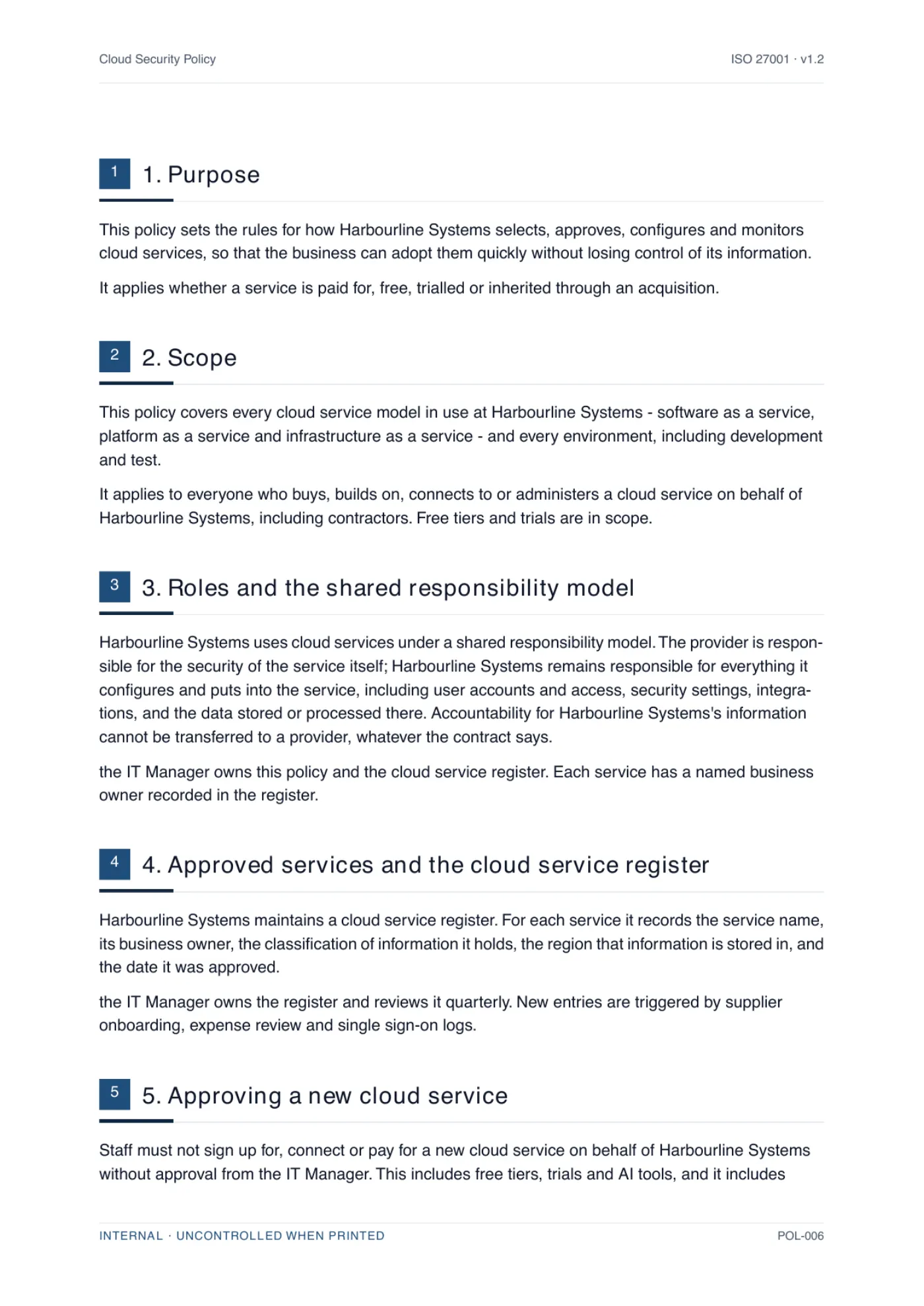
Same structure as the guide, with none of the decisions left to you: your service models named, your register owner and discovery triggers set, residency and retention written for the regions you actually use, and an exit note per critical service. It cites A.5.23, carries your branding, and exports to Word, PDF or Excel. The cover in the hero and the body page below are exactly that output, generated for an example company.

A body page of a generated cloud security policy, showing numbered clauses written for a specific business with the placeholders resolved.
Inside the document: every square bracket resolved to a real role, system and timeframe. Example branding shown.

Side by side

Writing it yourself vs generating it

Both routes end with the same 12 sections. What differs is how many of the decisions inside them you make alone, and who checks the result before an auditor does.

Scroll the table sideways to compare both routes.

Dimension Writing it yourself Generating it with PolicyMint
Getting the structure This page. Twelve sections, roughly a day of writing once you have the facts. The same twelve sections, already filled in from your business profile.
The shared responsibility clause The one people get wrong. Written once, then re-read every time you add a service model. Written against the service models you actually use, and consistent with your other documents.
Naming your services You supply the register, the owners and the regions - the part only you can know. Same, from your profile - and anything it cannot know is flagged rather than invented.
Checking it Nobody, until an auditor. That is the expensive place to find out. Three independent verifiers before you see it, against the standard's requirements.
Making it look like yours Your own formatting, headers and approval block, per document. Your logo and colors, exported to Word, PDF or Excel.
The rest of the set Every other document is another day, and keeping them consistent is the real work. The whole set stays consistent by construction. Your first document is free.
Generate this policy Free first document

Card required; no charge today. Documents in bulk, and the whole ISO 27001 set, are both on the pricing page.

ISO 27001 documents

36

ISO 27001 documents

tiered by what you actually need

ISO 42001 documents

21

ISO 42001 documents

for AI management systems

Clauses and controls mapped

182

Clauses and controls mapped

every document cites the ones it satisfies

Verifiers per section

3

Verifiers per section

on a different model to the writer

Cloud security policy FAQ

The questions people ask

Including who is actually responsible for what, and whether ISO 27001 demands this document.

What is a cloud security policy?

A cloud security policy is the document that sets the rules for how an organization selects, approves, configures and monitors cloud services such as SaaS, PaaS and IaaS. It states who may approve a new service, how data is protected and where it may be stored, what the provider is responsible for, what stays your job, and how you would leave a service if you had to.

What should a cloud security policy include?

Purpose and scope covering every service model and everyone who signs up for services; the shared responsibility split; an approval route and a cloud service register; due diligence checks before adoption; account, access and administrator rules; encryption and data residency requirements; secure configuration and change control; logging and monitoring; backup and an exit plan for each critical service; contract and breach notification requirements; and how exceptions, violations and reviews are handled.

Is the cloud provider responsible for security, or are we?

Both, and the split is the point of the policy. The provider secures the service: the data centers, the platform, the underlying infrastructure. You secure what you do with it: user accounts and access, multi-factor authentication, security settings, integrations, and the data you put in. The split moves with the service model, and you carry more of it in IaaS than in SaaS, but accountability for your information never transfers. A provider's certificate covers their side only.

Does ISO 27001 require a cloud security policy?

Effectively yes, for any organization that uses cloud services. Control A.5.23 of ISO/IEC 27001:2022 expects defined processes for the acquisition, use, management and exit from cloud services. An auditor will look for a documented rule set, a register of the services in use, evidence of due diligence and supplier agreements, and review records. A topic-specific cloud security policy is the standard way to satisfy it.

Is a free cloud security policy template enough for ISO 27001?

It is a real start, but not enough on its own. Certification looks at a whole consistent set - the Statement of Applicability, a risk methodology and register, and the topic policies your controls require - and for evidence the policy is real: a maintained register, due diligence records and reviews, not just a file on a drive. Auditors flag generic policies that do not match how a business runs. PolicyMint generates the full set written for your business; the first document is free.

What does a full ISO 27001 document set cost?

Writing one policy from a guide costs a day. A certifiable set is around 36 documents. Toolkits sell blank templates: Advisera publicly lists about A$1,300 (US$897)US$897about £660 (US$897)about €780 (US$897) one-time and IT Governance about A$760 (£395)about US$530 (£395)£395about €460 (£395) for the first year, and you still write every document yourself. PolicyMint delivers the finished set, written for your business and checked before you see it, for A$350US$229£179€209 including GST, about A$8.75US$5.73£4.48€5.23 per finished document.

PolicyMint / Next issue Ready when you are

Stop staring at an empty document set

Set up your business once. Get the documents you actually need, written for how you really operate, in your branding, checked before you see them.

Your first document is on us. We ask for a card to begin and you are not charged for it, and there is no sales call. See pricing