From 10 December 2026 · APP 1.7 to 1.9 · Free template
Automated Decision-Making
Privacy Policy Template
From 10 December 2026, if software makes or substantially helps make decisions that could
significantly affect people, your privacy policy has to say so. Here is the section to add, free
to copy or download as Word with no sign-up, followed by the three-part test that decides whether
it applies to you, worked examples, and the mistakes that make it misleading.
Rather have it written? PolicyMint writes the section and the
decision inventory behind it from your answers. Your first document is free.
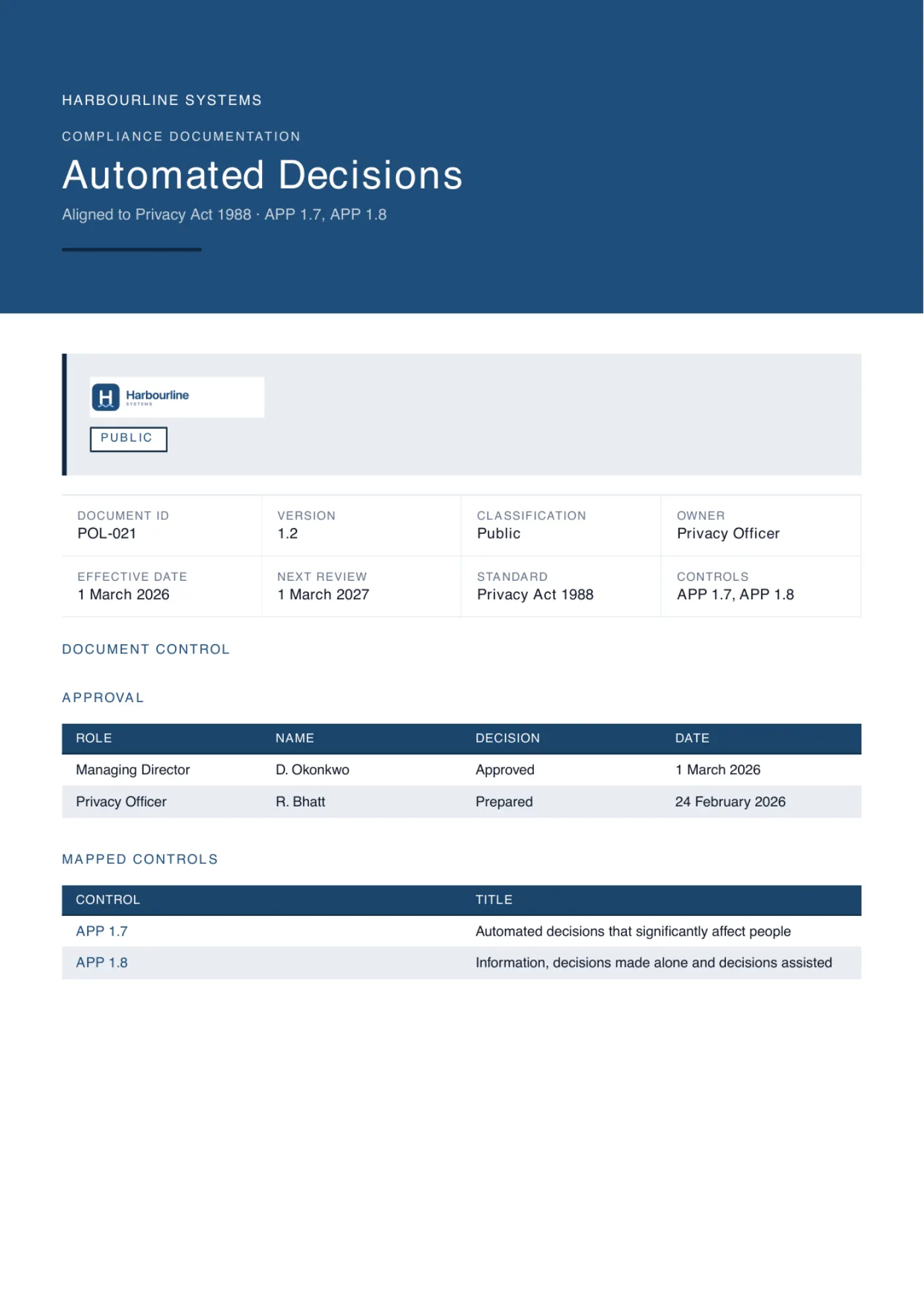
Generated from this page's structure, in an example company's branding
Free template
Free automated decisions privacy policy section
The complete automated decisions section, free to copy from this page or download as an editable Word document.
No sign-up. Replace every [bracketed placeholder] with your own details, delete anything that
does not apply, and have it approved before you rely on it. The guide below
explains what each section has to contain and what an auditor checks.
The section to add to your privacy policy if computer programs make, or substantially help make, decisions about people. Replace the bracketed placeholders.
[Organisation name] uses computer programs to make, or help make, some decisions that could significantly affect you. This section explains the kinds of personal information those programs use and the kinds of decisions they are involved in.
1. How we use computer programs in decisions
We use [the kinds of program, e.g. automated screening software, an AI tool built into our booking system] to [what they are used for, in plain categories, e.g. assess applications, detect fraudulent payments, set individual prices].
2. The personal information these programs use
These programs use the following kinds of personal information:
[Identity details, e.g. your name, date of birth and identity document details].
[Information you give us, e.g. the details in your application].
[History with us, e.g. your account and payment history].
[Information from other sources, e.g. credit or tenancy database checks].
[If a program uses sensitive information, such as health information, name it here as a separate item.]
3. Decisions made by computer programs alone
[The kinds of decision a program makes without a person making the decision, e.g. applications that score below a set threshold are declined automatically.] [If there are none:] None of the decisions described here is made by a computer program alone.
4. Decisions computer programs help us make
[The kinds of decision a person makes where a program does something substantially and directly related to making it, e.g. our staff decide all other applications, relying on the program's score and the checks it runs.]
5. Questions about these decisions
If you have a question about a decision that involved a computer program, or want to make a complaint, contact us using the details in this privacy policy. [If the Privacy Act covers you:] If you are not satisfied with our response, you can complain to the Office of the Australian Information Commissioner (OAIC) at www.oaic.gov.au.
This template is a starting point, not legal advice. APP 1.7 to 1.9 of the Privacy Act 1988 (Cth) apply to decisions made from 10 December 2026, including decisions made by programs set up before then. Describe kinds of information and decisions in plain categories, without technical detail.
Does it apply to you?
The three-part test in APP 1.7
Your privacy policy needs this section when all three are true for a program you use. Answer them for
each program that touches decisions about people. If you are unsure about a part, the OAIC's advice
is to take the cautious approach and include it.
Part 1
Have you arranged for a computer program to make a decision, or to do something substantially and directly related to making it?
Any computer program counts: rule-based software, a spreadsheet formula, machine learning, a generative AI tool. So does one a vendor runs for you, because you arranged for it. A score, ranking or recommendation is substantially and directly related to a decision when it is a key factor in the person's decision and directly connected to it, even though the person makes the final call.
Part 2
Could the decision reasonably be expected to significantly affect someone's rights or interests?
The effect has to be more than trivial, and can be good or bad for the person. APP 1.9 gives examples: decisions about a benefit under a law, a person's rights under a contract, or their access to a significant service or support. The OAIC treats access to housing, employment, healthcare and aged care, education, financial assistance, essential banking and credit, telecommunications and essential utilities as generally in scope. Refusing or failing to decide is itself a decision.
Part 3
Is personal information about the person used in running the program?
Information about the person the decision is about, including information you get from someone else, such as a credit or tenancy database check.
It applies to organisations the Privacy Act covers, which leaves out most businesses with an annual
turnover of $3 million or less unless an exception applies. See
does the Privacy Act cover your business?
The writing guide
How to write the automated decisions section
6
sections
2
with real wording
5
questions to answer
6
failure modes
a few hours
to write it yourself
APP 1.8 asks for three things: the kinds of personal information the programs use, the kinds of
decisions they make on their own, and the kinds of decisions where they do something substantially
and directly related to a person's decision. Describe each in categories a reasonable person
understands, without technical detail. Two clauses decide whether the section is accurate, so those
come with example wording.
1
Opening statement
What it must contain
One or two sentences: you use computer programs to make or help make decisions that could significantly affect people, and this section explains the information and decisions involved.
What to check
That it reads as part of your privacy policy and describes what you do now. The law's start date is not the date your practices began, so do not date the section or the practices it describes.
2
How we use computer programs in decisions
What it must contain
The kinds of program and what they are used for, in categories a reasonable person understands: assessing applications, detecting fraud, setting prices. AI and ordinary software both count.
What to check
Plain categories, with no technical detail and no trade secrets. APP 1.8 asks for kinds of decisions and information, not how a model works.
3
The personal information these programs use
What it must contain
The kinds of personal information used in running the programs (APP 1.8(a)), grouped meaningfully, with any sensitive information, such as health information, named separately.
What to check
That the list matches what the programs really draw on, including information from outside sources.
4
Decisions made by computer programs alone
What it must contain
The kinds of decisions made solely by a program, with no person making them (APP 1.8(b)). If there are none, say so in one sentence.
What to check
That every fully automatic decision is here, described plainly enough that the person affected recognises it.
Wording that works
Applications that score below a set threshold are declined automatically, without a person looking at them.
It names the decision and its trigger in plain words, and says plainly that no person is involved.
5
Decisions computer programs help us make
What it must contain
The kinds of decisions a person makes where a program does something substantially and directly related to making them, such as a score or recommendation the person relies on (APP 1.8(c)).
What to check
An accurate account of who decides. Do not say a person reviews every decision, or can override the program, unless that is true.
Wording that works
Our staff decide all other applications, relying on the program's score and the checks it runs.
It says who decides and how much the program shapes the decision, without promising discretion or a review the business does not provide.
6
Questions about these decisions
What it must contain
Where to ask about a decision and how to complain, pointing to your privacy contact and, if the Act covers you, the OAIC.
What to check
No promise of a review or an explanation you do not provide. The privacy policy rule is about transparency.
The section in your policy is the public half. The other half is a register of every program you use
in decisions about people, each assessed against the test, with the wording your policy needs for the
ones in scope. It is how you answer these questions, and how the section stays true as your software
and suppliers change.
?
Which of your programs are in scope, and why?
Satisfies
A register of the programs you use in decisions about people, each assessed against the three-part test with its result recorded.
Fails
A section written from memory, with nothing behind it.
?
Why is this decision significant?
Satisfies
A reason recorded for each program, such as its effect on someone's access to housing, credit, employment or an essential service.
?
What information does it actually use?
Satisfies
Kinds of information that match the program's real inputs, including data from third parties.
?
Who makes the final call?
Satisfies
An accurate split between decisions the program makes alone and decisions a person makes with its help.
Fails
"All decisions are reviewed by a person" when some are declined automatically.
?
How do you keep it current?
Satisfies
A rule that staff report new programs and AI tools before relying on them, and a review whenever a program or its provider changes.
What goes wrong
The mistakes to avoid
!
Thinking a human in the loop takes you out of scope
A program whose score or recommendation is a key factor in a person's decision is doing something substantially and directly related to it. It is in scope even when the person makes the final call.
!
Waiting until 10 December
The rule applies to decisions made from that date, including by programs you already use. The section has to be in your privacy policy when the day begins.
!
Forgetting software you did not build
A screening, scoring or AI tool from a vendor counts if you arranged to use it in your decisions. The obligation sits with you, not the vendor.
!
Describing the algorithm
APP 1.8 asks for kinds of information and decisions in plain categories. Technical detail confuses readers and can give away trade secrets you do not have to disclose.
!
Promising a review you do not offer
The rule is about transparency, not a right of review. Offering a review on request is fine if you do it; promising one you do not provide is a commitment you can be held to.
!
No record behind the section
Keep an automated decision inventory: each program, the decisions it makes or informs, the information it uses and its assessment. It is how the section stays accurate as your software changes.
See the real output
What PolicyMint generates
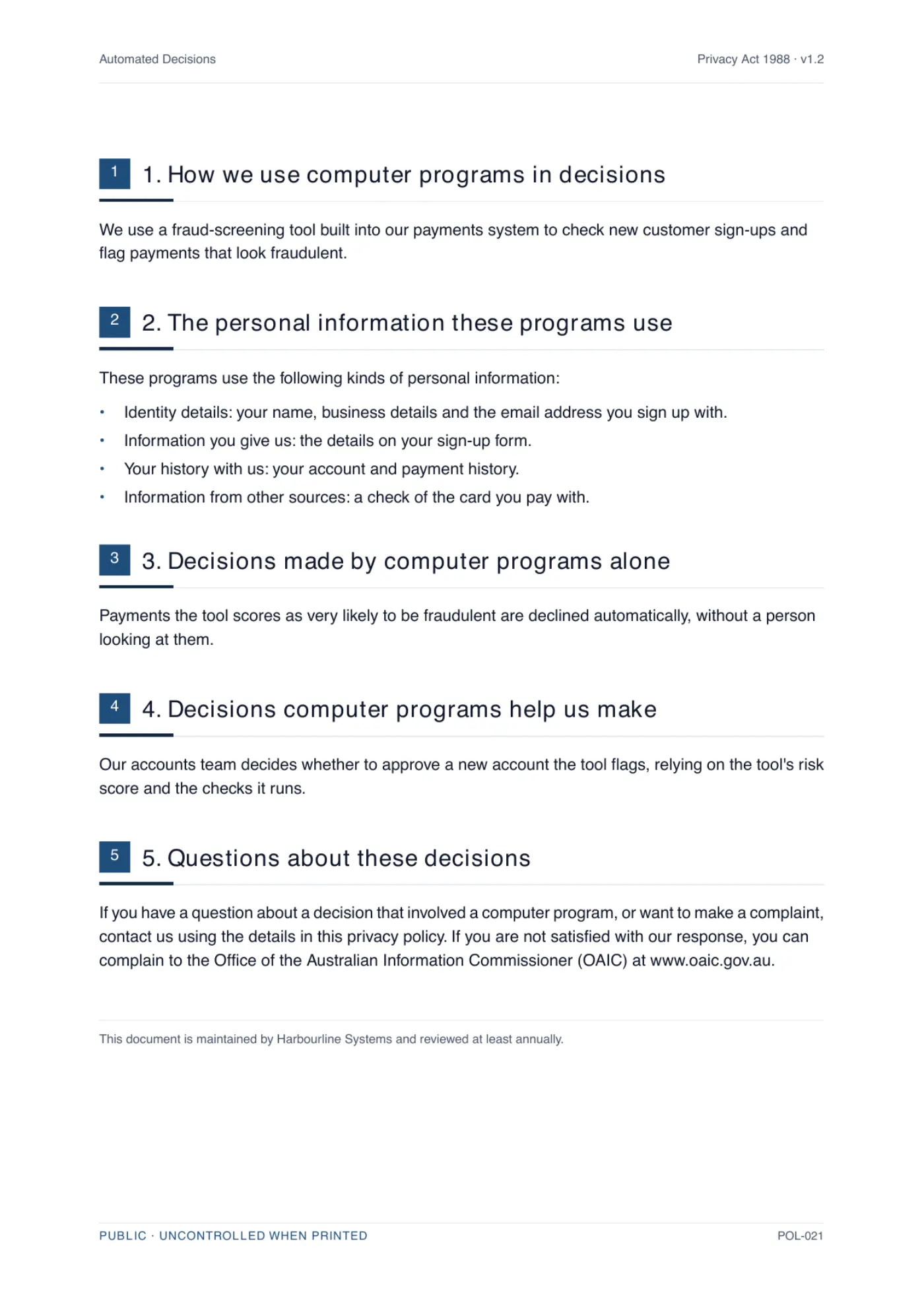
The cover in the hero and the page below are the section above run through PolicyMint's export path,
with an example company's branding applied. Generated for your business, it names the programs you
really use, the information they draw on and who makes the final call, checked against APP 1.7 and 1.8
before you see it. The full Privacy Act pack also writes your
privacy policy and the decision inventory behind it.
One page of the generated document, for an example company. The trial produces the whole
document, not a sample.
Side by side
Writing it yourself vs generating it
Dimension
Writing it yourself from this guide
Generating it with PolicyMint
What you end up with
The section in your own words, as accurate as your own review of your software
The section written from your answers about the programs you use and the decisions they make, ready to insert into your privacy policy
Deciding what is in scope
You apply the three-part test to each program yourself
Asks which decisions software makes or helps make, and applies the test to your answers
The record behind it
You build your own register, if you keep one
Also generates the automated decision inventory: every program assessed, with the policy wording each one needs
Checked before you use it
Your own review
Checked against APP 1.7 and 1.8 by three independent verifiers on a different AI model, plus a repair pass
Price
Your time
A$4.80US$3.12£2.40€2.88 for this section, and your first document is free
Automated decision-making FAQ
The questions people ask
Including who it applies to, and whether you have to offer a human review.
What is the automated decision-making rule in the Privacy Act?
From 10 December 2026, APP 1.7 to 1.9 require an organisation the Privacy Act covers to describe, in its privacy policy, its use of computer programs in decisions that could significantly affect people: the kinds of personal information the programs use, the kinds of decisions made solely by a program, and the kinds of decisions where a program does something substantially and directly related to a person's decision. The Privacy and Other Legislation Amendment Act 2024 added these rules.
When does it start?
On 10 December 2026. It applies to decisions made from that date, even where the program was set up, or the personal information collected, before then. So the section needs to be in your privacy policy before that day.
Does it apply to small businesses?
It applies to organisations the Privacy Act covers. Most businesses with an annual turnover of $3 million or less are exempt unless an exception applies: for example, they provide a health service and hold health information, trade in personal information without consent, or have opted in. An exempt business can still include the section voluntarily.
Is it only about AI?
No. It covers any computer program - a spreadsheet formula, rule-based software, machine learning or a generative AI tool - where the three-part test is met. A program a vendor runs for you counts if you arranged to use it in your decisions.
Do I have to explain how the program works?
No. The policy must describe the kinds of personal information and the kinds of decisions in a way a reasonable person understands. The rule does not require technical detail or trade secrets.
Do I have to offer a human review of automated decisions?
The privacy policy rule is about transparency: on its own it does not create a right to a human review. If you offer one, say so. If you do not, do not promise it, because the policy is a public statement you can be held to.
Is this template free?
Yes. The complete section is on this page and as an editable Word document, with no sign-up. Replace the placeholders with your own programs and decisions, delete what does not apply, and add it to your privacy policy. If you would rather have it written for you, PolicyMint writes the section and the automated decision inventory behind it from your answers; your first document is free, card required, no charge today.
How much does PolicyMint charge to write this section?
This section is a short document: A$4.80US$3.12£2.40€2.88 at the list rate, or 12 credits. Signing up grants 25 credits, so it is covered by the free trial, card required, with no charge today.
Ready when you are
Be ready for
10 December 2026
Tell PolicyMint which decisions your software makes or helps make. Get the privacy policy section, and the decision inventory behind it, written for your business and checked against the Privacy Act.