ISO/IEC 27001:2022 · Annex A
The full ISO 27001 Annex A controls list
ISO/IEC 27001:2022 lists 93 Annex A controls, grouped into 4 themes. Here is every control by reference and title, what each theme covers, and how you decide which ones apply and record that in your Statement of Applicability.
Last updated
Overview
What is the ISO 27001 controls list?
The controls list is Annex A of ISO/IEC 27001:2022: a catalog of 93 information security controls you choose from when you treat the risks your organization has identified. The 2022 revision reorganized the older set of 114 controls into 93, across 4 themes rather than 14 domains.
Annex A is a menu, not a mandate. You are not required to implement every control. You are required to look at each one, decide whether it is relevant to your scope, and justify any you leave out. That decision record is your Statement of Applicability, and it is what an auditor checks the controls against.
The controls
All 93 controls, by theme
Reference and title for every Annex A control. The detailed implementation guidance for each belongs to ISO 27002; this is the list itself.
Organizational controls A.5 · 37 controls
Governance-level controls: your security policies, roles and responsibilities, supplier and cloud relationships, incident management, continuity, and legal and compliance obligations.
| Ref | Control |
|---|---|
| A.5.1 | Policies for information security |
| A.5.2 | Information security roles and responsibilities |
| A.5.3 | Segregation of duties |
| A.5.4 | Management responsibilities |
| A.5.5 | Contact with authorities |
| A.5.6 | Contact with special interest groups |
| A.5.7 | Threat intelligence |
| A.5.8 | Information security in project management |
| A.5.9 | Inventory of information and other associated assets |
| A.5.10 | Acceptable use of information and other associated assets |
| A.5.11 | Return of assets |
| A.5.12 | Classification of information |
| A.5.13 | Labelling of information |
| A.5.14 | Information transfer |
| A.5.15 | Access control |
| A.5.16 | Identity management |
| A.5.17 | Authentication information |
| A.5.18 | Access rights |
| A.5.19 | Information security in supplier relationships |
| A.5.20 | Addressing information security within supplier agreements |
| A.5.21 | Managing information security in the ICT supply chain |
| A.5.22 | Monitoring, review and change management of supplier services |
| A.5.23 | Information security for use of cloud services |
| A.5.24 | Information security incident management planning and preparation |
| A.5.25 | Assessment and decision on information security events |
| A.5.26 | Response to information security incidents |
| A.5.27 | Learning from information security incidents |
| A.5.28 | Collection of evidence |
| A.5.29 | Information security during disruption |
| A.5.30 | ICT readiness for business continuity |
| A.5.31 | Legal, statutory, regulatory and contractual requirements |
| A.5.32 | Intellectual property rights |
| A.5.33 | Protection of records |
| A.5.34 | Privacy and protection of personal identifiable information (PII) |
| A.5.35 | Independent review of information security |
| A.5.36 | Compliance with policies, rules and standards for information security |
| A.5.37 | Documented operating procedures |
People controls A.6 · 8 controls
The human side: screening, terms of employment, security awareness and training, the disciplinary process, and event reporting.
| Ref | Control |
|---|---|
| A.6.1 | Screening |
| A.6.2 | Terms and conditions of employment |
| A.6.3 | Information security awareness, education and training |
| A.6.4 | Disciplinary process |
| A.6.5 | Responsibilities after termination or change of employment |
| A.6.6 | Confidentiality or non-disclosure agreements |
| A.6.7 | Remote working |
| A.6.8 | Information security event reporting |
Physical controls A.7 · 14 controls
Protecting facilities and equipment: secure areas, physical entry, clear desk and screen, storage media, and safe disposal or re-use.
| Ref | Control |
|---|---|
| A.7.1 | Physical security perimeters |
| A.7.2 | Physical entry |
| A.7.3 | Securing offices, rooms and facilities |
| A.7.4 | Physical security monitoring |
| A.7.5 | Protecting against physical and environmental threats |
| A.7.6 | Working in secure areas |
| A.7.7 | Clear desk and clear screen |
| A.7.8 | Equipment siting and protection |
| A.7.9 | Security of assets off-premises |
| A.7.10 | Storage media |
| A.7.11 | Supporting utilities |
| A.7.12 | Cabling security |
| A.7.13 | Equipment maintenance |
| A.7.14 | Secure disposal or re-use of equipment |
Technological controls A.8 · 34 controls
The technical controls: access and authentication, cryptography, logging and monitoring, network security, malware protection, and secure development.
| Ref | Control |
|---|---|
| A.8.1 | User endpoint devices |
| A.8.2 | Privileged access rights |
| A.8.3 | Information access restriction |
| A.8.4 | Access to source code |
| A.8.5 | Secure authentication |
| A.8.6 | Capacity management |
| A.8.7 | Protection against malware |
| A.8.8 | Management of technical vulnerabilities |
| A.8.9 | Configuration management |
| A.8.10 | Information deletion |
| A.8.11 | Data masking |
| A.8.12 | Data leakage prevention |
| A.8.13 | Information backup |
| A.8.14 | Redundancy of information processing facilities |
| A.8.15 | Logging |
| A.8.16 | Monitoring activities |
| A.8.17 | Clock synchronization |
| A.8.18 | Use of privileged utility programs |
| A.8.19 | Installation of software on operational systems |
| A.8.20 | Networks security |
| A.8.21 | Security of network services |
| A.8.22 | Segregation of networks |
| A.8.23 | Web filtering |
| A.8.24 | Use of cryptography |
| A.8.25 | Secure development life cycle |
| A.8.26 | Application security requirements |
| A.8.27 | Secure system architecture and engineering principles |
| A.8.28 | Secure coding |
| A.8.29 | Security testing in development and acceptance |
| A.8.30 | Outsourced development |
| A.8.31 | Separation of development, test and production environments |
| A.8.32 | Change management |
| A.8.33 | Test information |
| A.8.34 | Protection of information systems during audit testing |
Applicability
From the list to your Statement of Applicability
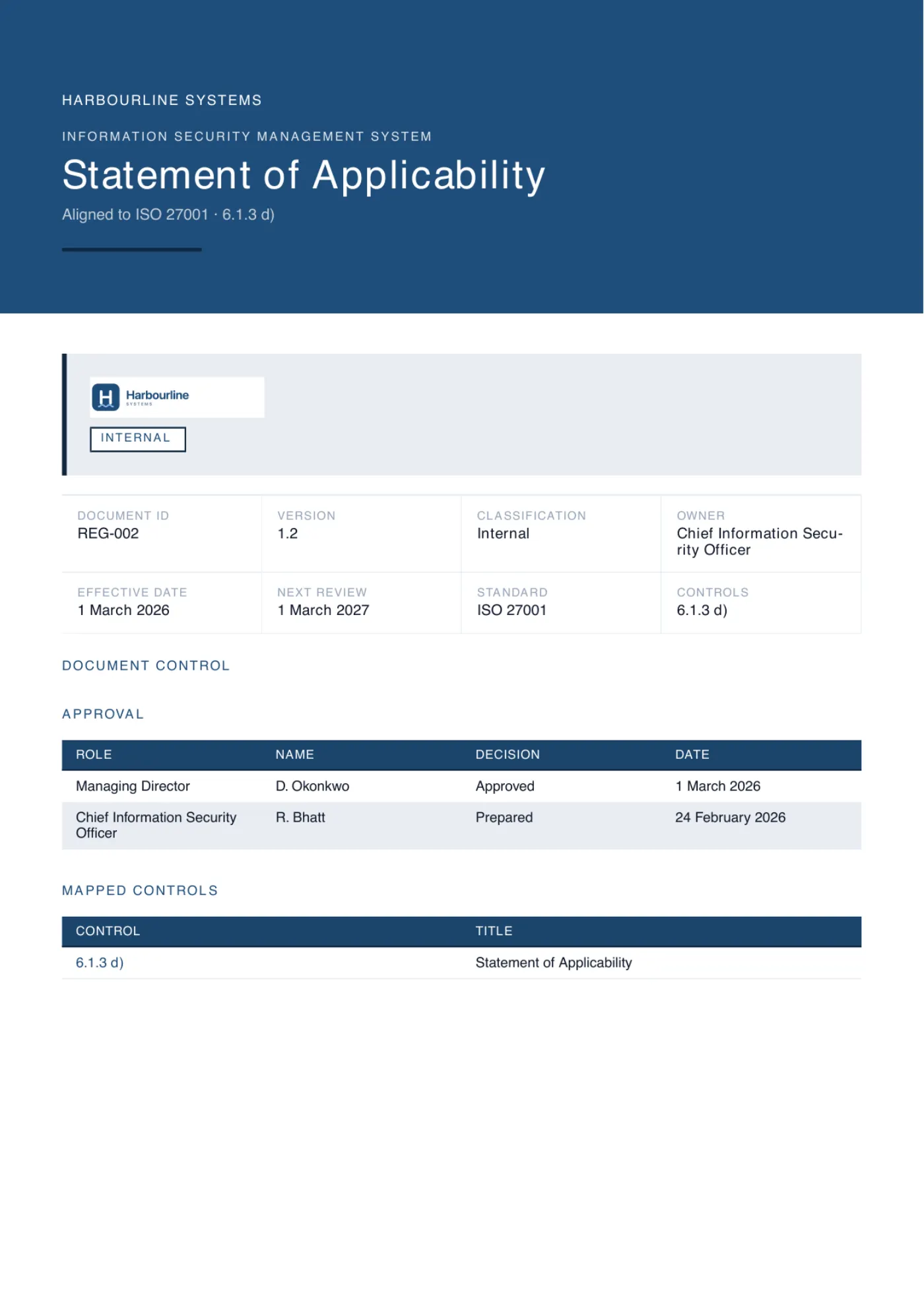
The controls list is the starting point. Certification turns on what you do with it: selecting the applicable controls, implementing them with real policies and procedures, and recording every applicable-or-excluded decision, with a justification, in your Statement of Applicability. Comparing what you currently have against these controls is a gap analysis, and it is the sensible first step.
PolicyMint generates that documentation. It selects the controls that fit your business profile, writes the policies and procedures that satisfy them, and assembles your Statement of Applicability so it never drifts from the documents behind it. See the full ISO 27001 documentation set it generates, or, if you are writing the top-level document yourself first, our information security policy template guide covers its structure, what an auditor checks and the clauses teams get wrong.
If you want to track implementation status control by control, our sister tool ControlStack maps the same 93 controls in an interactive tracker: PolicyMint generates the documents, ControlStack tracks where each control stands.
ISO 27001 controls FAQ
ISO 27001 controls, answered
The questions people ask when they first meet Annex A.
How many controls are in ISO 27001:2022?
The 2022 revision has 93 Annex A controls, grouped into 4 themes: Organizational (37), People (8), Physical (14) and Technological (34). The earlier 2013 version listed 114 controls across 14 domains; the 2022 update merged and modernised them into 93.
What are the four ISO 27001 control themes?
Organizational (A.5), People (A.6), Physical (A.7) and Technological (A.8). The theme is just how Annex A is organized; the reference number of each control tells you which theme it sits in.
Do I have to implement all 93 controls?
No. Certification requires you to consider every control, apply the ones relevant to your scope and risks, and record a justification for any you exclude. That record is your Statement of Applicability. Most organizations apply a large majority, but rarely all 93.
What is the difference between a control and a clause?
Clauses 4 to 10 are the mandatory management-system requirements every certified organization must meet. Annex A controls are the security measures you select from, based on your risk assessment, to treat the risks you have identified.
Where does this controls list come from?
It is Annex A of ISO/IEC 27001:2022, with implementation guidance in the companion standard ISO/IEC 27002:2022. We publish the reference and title of each control; the detailed guidance text remains the property of ISO and IEC.
Can I download the ISO 27001 Annex A controls as a spreadsheet?
We do not publish one. The reference and title of every control are on this page; the list itself belongs to ISO and IEC, and a bare spreadsheet of it is not what an auditor asks for anyway. The spreadsheet they do ask for is the Statement of Applicability: all 93 controls, one row each, with an included-or-excluded decision, a justification and the document that implements it. PolicyMint assembles that from your scope and exports it as Excel, alongside the Word and PDF documents behind it.
How does PolicyMint help with the controls?
It selects the applicable controls from your business profile, generates the policies and procedures that satisfy them, and assembles your Statement of Applicability so it stays in step with the documents behind it.
Ready when you are
Stop staring at an empty document set
Set up your business once. Get the documents you actually need, written for how you really operate, in your branding, checked before you see them.
Your first document is on us. We ask for a card when you download it and you are not charged for it, and there is no sales call.